
In a previous issue of Weightology Weekly, I wrote about insulin and how it's been unfairly demonized by many in the nutrition field. This demonization has been based on a number of misconceptions regarding insulin, its biological effects, and its secretion. I want to continue clarifying these misconceptions.
MYTH: Insulin Spikes are "Bad"
FACT: Insulin Spikes Serve a Normal & Important Physiological Function
In my previous article, I discussed how dietary protein can cause insulin spikes just like dietary carbohydrate, and these spikes are not related to gluconeogenesis from the protein (i.e., the protein being converted to sugar). I also showed how these spikes are partly responsible for the suppression of appetite that is caused by dietary protein (due to insulin's effects on your brain to inhibit appetite).
I want to expand on the importance of rapid insulin spikes due to feeding, and how they are important in blood sugar regulation. To do this, we need to discuss the phases of insulin secretion. Insulin secretion from your pancreas comes in two phases. The first phase happens very quickly; your pancreas senses rising glucose, and insulin is released within 1-2 minutes of this rise in blood sugar. This rapid-phase response is the result of your pancreas releasing stored insulin. It is typically over within 10 minutes. This rapid-phase response has been found to be impaired in people with impaired glucose tolerance (people who have higher blood sugar responses to meals than normal, and higher fasting levels of blood sugar, but who are not diabetic). This rapid-phase response is completely absent in people with type 2 diabetes.
There is a second phase that continues as long as glucose is elevated. This release of insulin is achieved by the release of stored insulin, as well as the creation of new insulin (insulin is created from a precursor called proinsulin). When you infuse glucose into the blood of healthy people and type 2 diabetics, you get insulin responses that look like this:
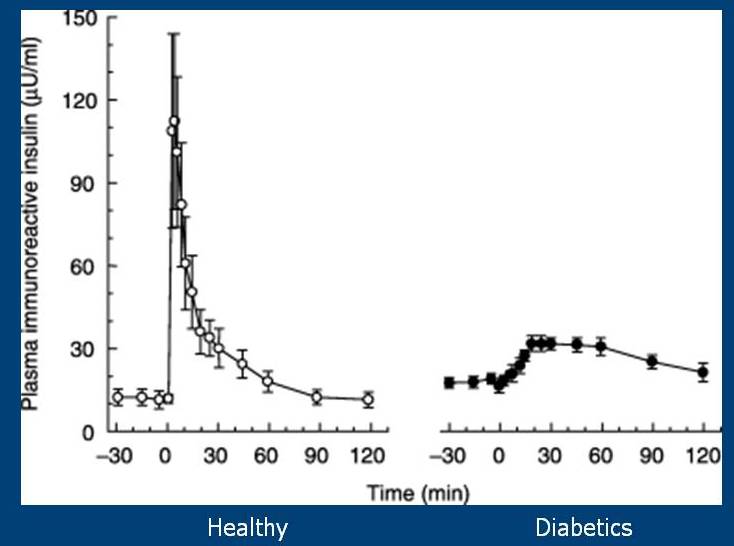
Insulin Response to Intravenous Glucose Administration in Healthy People Versus Type 2 Diabetics
You can see that the diabetics completely lack the rapid phase response that is present in the healthy individuals.
There is a drug called exenatide (Byetta), which has been found to restore this rapid phase insulin response in diabetics:
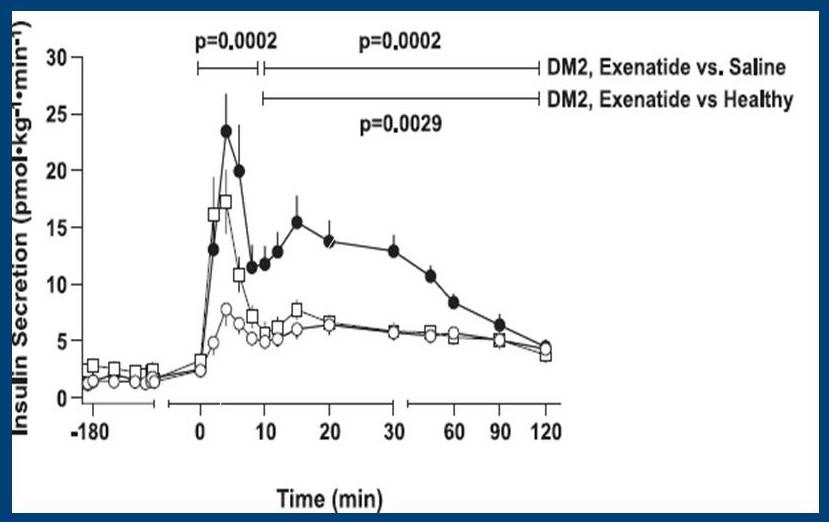
Insulin responses of type2 diabetics and healthy individuals, who have been administered glucose intravenously. Circles represent the insulin response of the type 2 diabetics when given a placebo. Squares represent the insulin response of the diabetics when given exenatide. You can see that exenatide restores the rapid phase insulin response. Black circles represent the insulin response of healthy individuals.
This restoration of the rapid phase insulin response improves blood sugar regulation in diabetics:
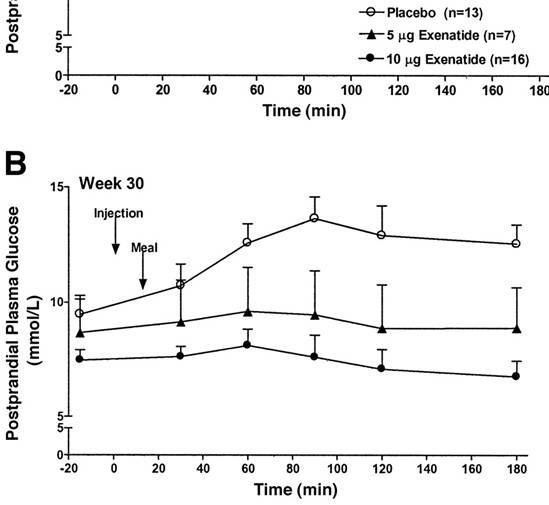
Blood sugar response to a meal in type 2 diabetics. Circles represent subjects on a placebo. Dark triangles and circles represent subjects on exenatide. You can see that blood sugar remained steady in the subjects on exenatide, but gradually increased in the subjects on the placebo.
You can see in the above chart that blood sugar remained consistent in response to a meal in the subjects on exenatide, but it increased over time in the subjects on the placebo.
Many people like to blame obesity and weight gain on insulin, but exenatide, which restores insulin spikes in type 2 diabetics, causes weight loss:
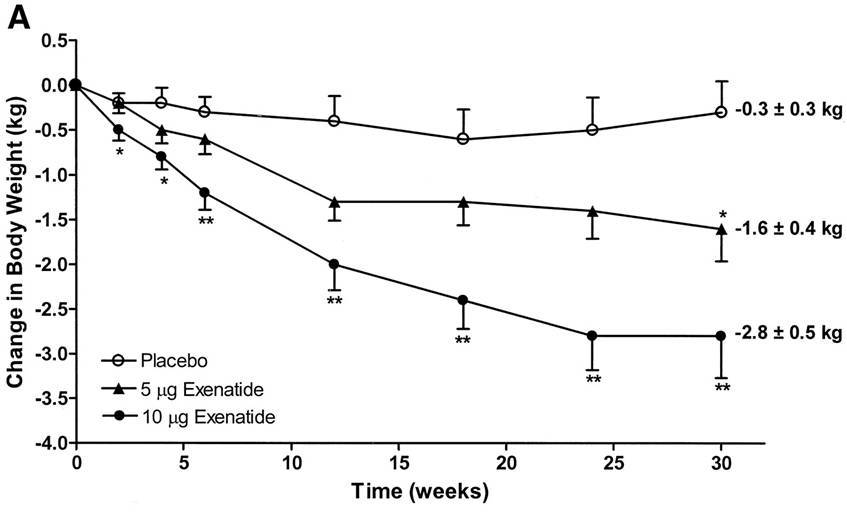
Effects of exenatide (Byetta) on body weight
Part of this weight loss is due to an improvement in satiety. Exenatide is a drug that mimics the effects of a hormone called glucagon-like peptide-1 (GLP-1). GLP-1 is an intestinal insulin-stimulating hormone (known as an incretin). GLP-1 potentiates insulin secretion, enhances the synthesis of insulin, upregulates insulin gene expression, and inhibits glucagon (insulin's opposing hormone) secretion. Yet Exenatide, which mimics GLP-1 and helps stimulate insulin secretion, causes weight loss.
The fact is that rapid insulin spikes in and of themselves are not a bad thing. Protein causes rapid insulin spikes, yet protein reduces appetite and helps with weight loss. GLP-1 and drugs like exenatide contribute to insulin spikes, yet they reduce appetite and cause weight loss. The problem is that people confuse insulin spikes and blood glucose spikes. It is well established that rapid rises and falls in blood glucose can contribute to hunger. Because rapid rises in blood glucose also cause rapid rises in insulin, people end up blaming insulin (and the effects of high glycemic carbohydrates on insulin) for the problem.
MYTH: Since diabetics who inject insulin gain weight, this means that insulin is the reason for weight gain in non-diabetics
FACT: Amylin is co-secreted with insulin in non-diabetics; amylin has appetite suppressant and lipolytic effects
I would like to thank Dr. Stephan Guyenet for this information. I had known about amylin but hadn't looked into it in any great detail. Amylin is a hormone that is secreted by your pancreas at the same time as insulin. Amylin decreases appetite, and also stimulates lipolysis (the breakdown of fat into fatty acids).
Type 1 diabetics do not produce amylin, and amylin secretion is impaired in type 2 diabetics. Pramlintide, a drug that mimics the effects of amylin, has been found to produce weight loss in diabetics.
This information demonstrates that the effects of insulin injection in a diabetic cannot be compared to the effects of physiological changes in insulin in a non-diabetic, yet many people erroneously make this comparison as if they are similar.
MYTH: Lowering Insulin Will Improve Appetite Regulation
FACT: Insulin Is One of the Many Hormones Critical to Satiety
I already most addressed this myth in my previous article on insulin, showing how protein stimulated insulin secretion and helped reduce appetite, and also showing how insulin injection into the brain reduces appetite. I again want to thank Dr. Guyenet for this information, but when you knock out the insulin receptors of a mouse's brain, the mouse will overeat and develop obesity.
MYTH: All of this information only applies to healthy people
FACT: The information applies to obesity and diabetes
On other forums, I saw people comment on my previous article and claim that the information I provided only applied to healthy people, and not diabetics or obese individuals. They continued to believe that treating diabetes and obese individuals was all about insulin control. Nothing could be further from the truth. Not only is this evident from information mentioned earlier in this article (such as how exenatide restores insulin spikes and improves blood sugar control and body weight in diabetics), but it is also evident from the fact that high protein diets have been found to help both diabetics and obese individuals, despite the fact that protein is a powerful stimulus of insulin secretion.
As I mentioned earlier, people seem to confuse blood glucose control and insulin control. It is the management of blood glucose itself that is partly responsible for the health benefits of low-glycemic carbohydrates, or reducing carbohydrates, or increasing protein intake, or consuming dietary fiber, or consuming fruits and vegetables, or consuming whole foods over processed foods. It is not the control of insulin; the control of insulin ends up being a byproduct of these other behaviors through improvements in insulin sensitivity (how responsive your cells are to insulin) and reductions in blood sugar swings.
Remember, insulin is not the bad guy. Click here to read part 3 of this series, where I discuss how dairy products are extremely insulinemic, yet do not promote weight gain.
Thank you for this. I’ve always been underweight (hereditary), using carbs well without weight gain or inflammation. I understand you to be saying that it is the excess (whatever that means for you) of carb intake over energy expenditure that causes problems, not carbs themselves. This past summer I had a DCIS lesion removed and was warned to limit insulin spikes, as they can contribute to tumor recurrence. I “went paleo” and felt ok, but dropped too much weight. I also developed joint pain. So I slowly re-introduced carbs/sugars and it has helped. But my paleo endo tells me the… Read more »
Hi, Kay,
I really don’t see how the carbs would be contributing to inflammation. There could be a myriad of reasons why CRP is up, and it may have nothing to do with your diet. I would not be surprised that menopause may be playing a role.
Just started to read this. It is interesting, and I have not finished, so I have not made up my mind yet about this article.
Yes, you are right: Gary has a CARB/insulin hypothesis NOT a PROTEIN/insulin hypothesis. You are right in blaming the carbs.
Sabine, Gary implicates insulin as the mechanism behind which carbs are supposedly fattening. But if this was true, any food that is insulinemic should be fattening. Yet we know this is not the case.
On top of that, there are controlled studies using high carbohydrate diets (including high sugar intake) that show weight loss.
The “carb/insulin” hypothesis is a failed hypothesis. It fails on so many levels that it’s impossible to count. The fact that Taubes continues to promote such nonsense in the face of overwhelming evidence against him is quite telling.
Hi, I definitely agree with you and laud the citations you make. It seems insulin is just doing important tasks just right and is not to be blamed for fat gain, and its high blood sugar that is bad. But here is the deal – even if high blood sugar is bad, the carbblame circle is still intact – it just doesnt have the insulin link in it now thanks to your articles. To be specific, from [ excessive carbs > sugars > insulin > lipogenesis ], we can go to [ excessive carbs > sugars > insulin > lipogenesis… Read more »
Do you mind if I quote a couple of your posts as long as I provide credit and sources back to your website? My blog is in the very same area of interest as yours and my users would genuinely benefit from a lot of the information you present here. Please let me know if this ok with you. Appreciate it!
No problem, Adalberto, as long as you credit the sources
In your article why do you use research that is focused on the acute response of insulin?
It seems like a bit of sophistry on your part.
What is relevant is the chronic level of insulin in the body and hunger, not an acute response.
Someone left the following over at Robb Wolf’s blog that more pointedly describes what I tried to say: “It seems to me that saying insulin has an ‘acute anorexigenic effect’ is like saying cocaine has an acute positive psychological effect. Technically true but missing the point.” I would take it a step further and say that you are intentionally misleading. I am greatly disappointed, because I was looking for a detractor of Taubes and Low Carb that seemed to have some legitimacy. I read what the low carb diet promoters had to say and wanted a second contrarian opinion before… Read more »
Insulin in the above studies was measured before, during and after the meal.
At what other time did you want to have it measured?
The “chronic” level would be the fasted level after meals.
Good luck in your quest to live without insulin!
Thank your for the great information. I wonder why you not allow to copy your article, as Id like to save them on my pc.
Olanzapine (Zyprexa) causes insulin levels to increase dramatically. Healthy adults experience big weight gain as a side effect of Zyprexa. How do you explain this?
Thank you for the articles; very interesting. Please help me understand one thing about the first two graphs in this section. They seem to indicate lower insulin levels in type 2 diabetics than in the control group of normal individuals. I was under the impression that type 2 diabetics actually tend to have higher insulin levels than normal individuals; their bodies simply don’t respond to it (insulin resistance). Am I misreading the graphs, or am I just wrong about type 2 diabetes? (Quite possible, and I won’t be offended if that’s the case!)
Greg,
The graphs show the rate per unit time of insulin secretion by the pancreas. This is not the same thing as overall insulin levels in the blood (which are function of both secretion and removal).
So you are maintaining that any calories controlled diet will work equally well? So 2000 kcal is 2000kcal and it doesn’t matter what macros you eat for weightloss? I have to say this is counter to my experience. I ate 2,500 kcal a day, weighed and measured, food-pyramid recommendation and lost 10lbs in 6 months. I dropped my carb to 75-100g a day with no wheat and a single serving of berries and dropped 90lbs in 6 months. I think you have an axe to grind and are misrepresenting the facts. Why? I don’t know. I just know what you… Read more »
So you are maintaining that any calories controlled diet will work equally well? This is a strawman. I never made such an assertion. I ate 2,500 kcal a day, weighed and measured, food-pyramid recommendation and lost 10lbs in 6 months. I dropped my carb to 75-100g a day with no wheat and a single serving of berries and dropped 90lbs in 6 months. Unless you are simultaneously measuring your energy expenditure using doubly labeled water, and your food intake is tightly controlled under research conditions, your personal anecdote can hardly be constituted as evidence. I think you have an axe… Read more »
Fantastic, reminds me of the Malcolm Gladwell article from Martin Berkhan’s site
http://www.leangains.com/2010/06/malcolm-gladwell-on-low-carb-diets.html
Great post. Seems like you have a little spelling mistake, or missing a word, in the last sentence though..
“…where I discuss dairy products are extremely insulinemic, yet do not promote weight gain.”
Thanks for the catch. I corrected the mistake.