
It is no secret that, after losing weight, people have a tough time keeping it off. I mentioned in a previous issue of Weightology Weekly how only 17% of Americans are able to maintain a 10% weight loss after 1 year. Many people have repeatedly lost weight, only to regain it again and again. Even celebrities such as Oprah Winfrey struggle, despite having the money to have their own personal trainers and chefs.

Oprah Winfrey from February to December, 2005
We know that a change in body weight is caused by an imbalance between energy intake and energy expenditure. We also know that your body tries to resist weight change and correct this energy imbalance. For example, if you eat 2000 calories per day and suddenly decrease it to 1000, you will lose weight, but you will also get hungry in the process. This hunger drives you to eat more to bring you back into energy balance. This is one of the reasons why maintaining long-term weight loss is so difficult.
However, there are two sides to the concept of energy balance. There is not only food intake, but there is energy expenditure as well. Your body can resist a negative energy balance by not only making you more hungry, but by decreasing the number of calories you burn. The extent to which this happens in humans is not clear. The challenge of successful long-term weight loss could be partly because our bodies reduce their energy expenditure to the point that it makes it very easy to regain the weight.
Energy Expenditure Primer
To further investigate this issue, we first need to discuss what comprises the total number of calories you burn each day. Your daily energy expenditure consists of 3 components:
- Resting Energy Expenditure (REE). Also known as resting metabolic rate or RMR, this is the number of calories you burn to maintain basic life functions at rest, such as breathing and heart rate. It is measured while lying quietly after an overnight fast. The primary drivers of REE are your internal organs; other tissues like muscle and fat contribute as well, but to a much lesser degree. REE typically makes up 60% - 75% of the total calories you burn each day, but this can go down to 50% or less in highly active people.
- Activity Energy Expenditure (AEE). This is also referred to as non-resting energy expenditure (NREE). This is the number of calories you burn due to physical activity, and this means ANY type of physical activity, which includes fidgeting, maintenance of posture, and the movement of my fingers as I type this article. AEE will typically make up 17-32% of your total daily energy expenditure, but can be higher for very active people. AEE can be divided into two components:
- Exercise. This is formal, planned exercise, such as going to the gym or going out for a jog.
- Non-Exercise Activity Thermogenesis (NEAT). The majority of your energy expenditure comes from NEAT. This includes all activity that is not related to formal exercise, such as fidgeting or walking to your car.
- Thermic Effect of Feeding (TEF). This refers to the calories burned while digesting food. This typically makes up around 8% of your total daily energy expenditure.
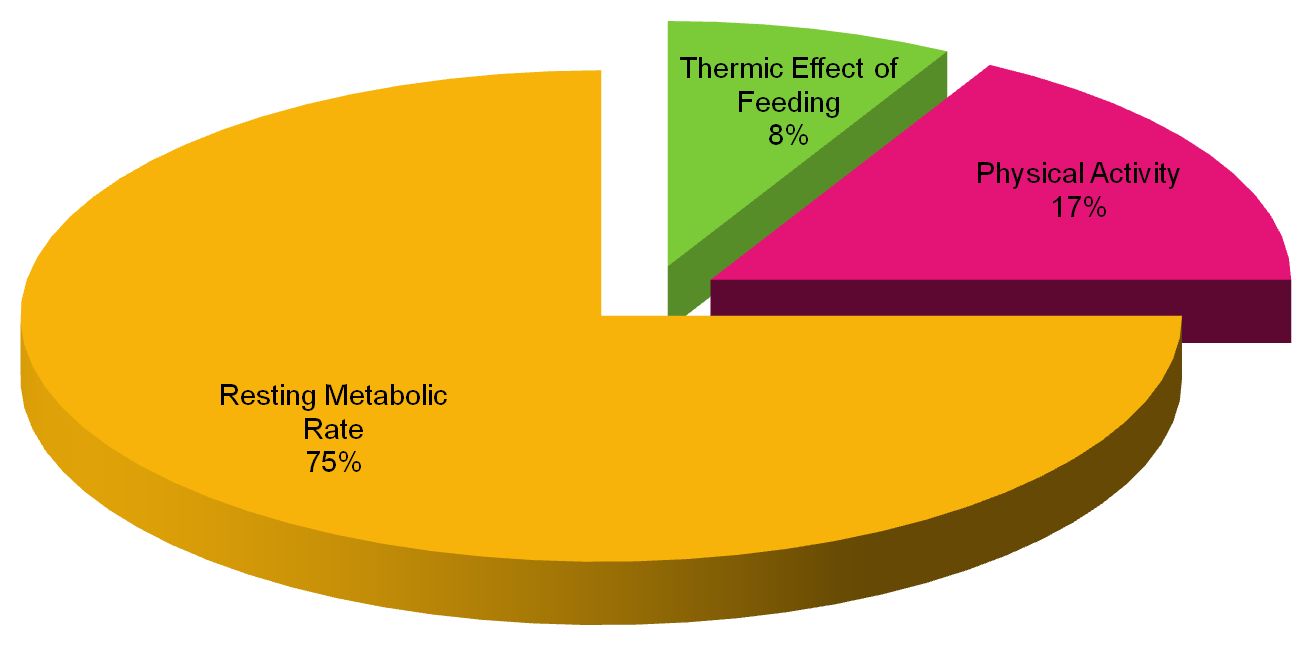
Components of Daily Energy Expenditure in a Sedentary Person
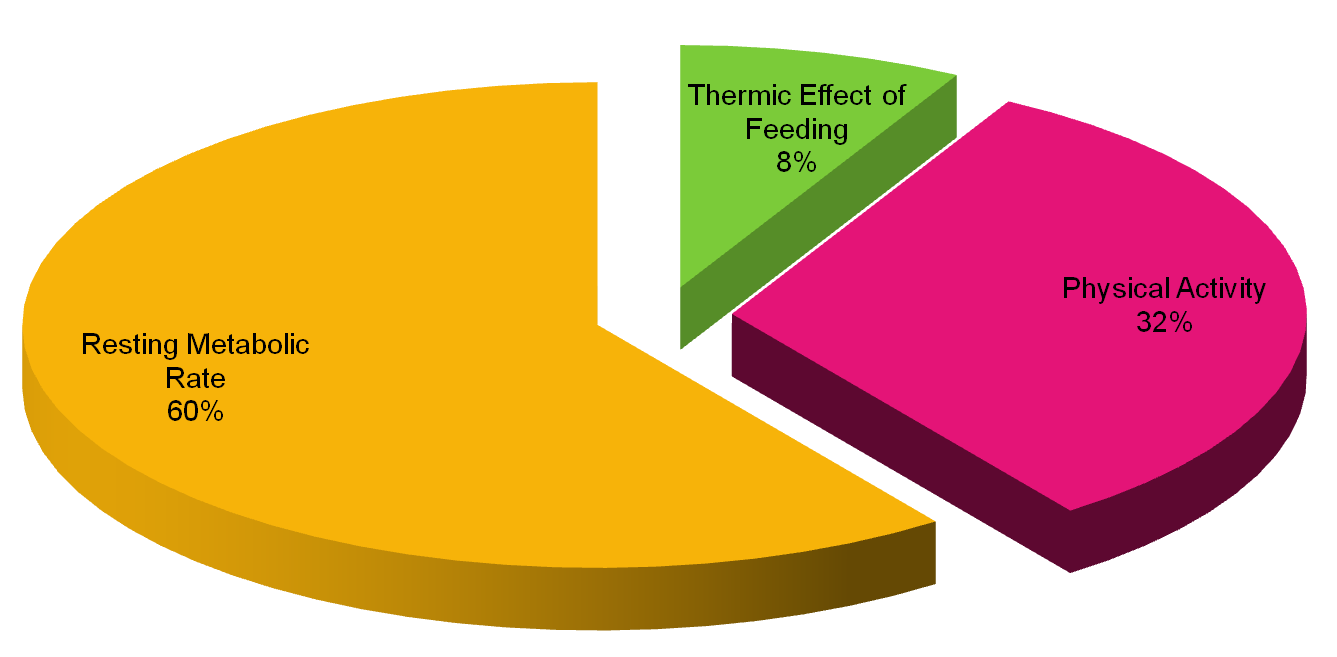
Components of daily energy expenditure in a physically active person
Now that we know what comprises energy expenditure, we need to look at how it responds to food restriction and weight loss. In animals, food restriction and weight loss cause a decrease in REE. However, there is an increase in spontaneous activity, likely due to stimulation of food-seeking behavior in the animal. Given that food is plentiful in human society and food-seeking behavior is not necessary, we cannot apply this animal data to humans.
Research has looked at how energy expenditure is affected by weight loss in humans. We know that weight loss will decrease energy expenditure from the simple fact that you have less weight to move around. However, the question is whether the decrease in energy expenditure is proportional to the weight lost, or if it is greater than what you would expect given the weight lost. If the decrease is greater than what you would expect, then that means your body is adapting to the weight loss and trying to conserve energy. In other words, you become more efficient. In terms of organ function and REE, you expend less calories for the same function. In terms of AEE, you either move less, or you expend less calories for the same movement.
When you look at the research in humans, the data is conflicting. Some research has shown greater decreases in energy expenditure than you would expect based on weight loss alone (a phenomena known as adaptive thermogenesis), yet other studies have failed to confirm these observations. There are many possible sources of error in these studies that may contribute to the conflicting results. For example, some of the studies that have looked at this problem have used the doubly-labeled water technique to measure energy expenditure in free living people. These studies assumed the person was weight stable. However, if the person is very slowly gaining weight, then an abnormally low energy expenditure will not be detected. For example, let's say I have a truly weight stable, 200 pound person (person A) with an energy expenditure of 3000 calories per day. Let's also say that this person has never had a weight problem. Because this person is weight stable, I know that he needs 3000 calories per day to maintain his weight. Now I take another 200 pound person (person B) who used to be 250 pounds. I think he is weight stable, and his energy expenditure is also 3000 calories per day. I compare him to person A. Since they are both expending 3000 calories per day, I assume that person B's energy expenditure is normal for his body weight. I then infer that person B needs to eat 3000 calories per day to maintain his weight. However, let's say that person B is slowly gaining weight and I don't know it. This means that person B needs to eat less than 3000 calories to maintain his weight (let's say 2800). If person A needs to eat 3000 to maintain his weight, but person B only needs 2800, then person B will be more energy efficient. However, I will fail to detect this because I assumed that person B was weight stable.
An Elegant Study
To get a better handle on how long-term weight loss will impact energy expenditure, and whether adaptive thermogenesis occurs in humans, Rudolph Leibel, a well-known researcher in metabolism and weight loss, and his colleagues performed a study on people who had lost at least 10% of their weight and kept it off for more than a year. The researchers examined 7 trios of subjects. Each trio consisted of the following:
- A subject who was at his/her usual weight
- A subject who lost at least 10% of his/her weight, and had maintained it for the last 5-8 weeks
- A subject who lost at least 10% of his/her weight, and maintained the loss for at least a year
The subjects were matched for sex, meaning that each trio would contain all males or all females. They were also matched for weight, meaning that the subjects in a particular trio had similar body weights. The subjects lived in the clinical research center throughout the study. They were fed only a liquid formula diet, which contained 40% fat, 45% carbohydrate, and 15% protein. Their caloric intake was adjusted until weight stability was achieved. A stable weight was defined as a daily weight fluctuation of less than 10 grams for at least 2 weeks. The formula diet was important, as a mixed food diet can cause random shifts in weight due to shifts in salt and carbohydrate intake (which is another limitation of previous research in this area). Thus, diet and weight were precisely controlled. Since weight was stable, 24-hour energy expenditure had to match 24-hour energy intake. Thus, the subjects' calorie intake would also indicate the number of calories they were burning each day. REE was measured under a metabolic hood. TEF was measured by feeding the subjects when they were under the hood, and measuring the increase in metabolic rate. AEE was calculated by subtracting REE and TEF from total daily energy expenditure. Body composition was measured using hydrostatic weighing.
The researchers then took 83 subjects at their initial weight, and developed regression equations that related energy expenditure to age, fat-free mass, and fat-mass. The observed energy expenditures for the trios were then compared to what these equations predicted their energy expenditures should be.
Adaptive Thermogenesis: A Reality
The following chart shows the average energy expenditures of the subjects:
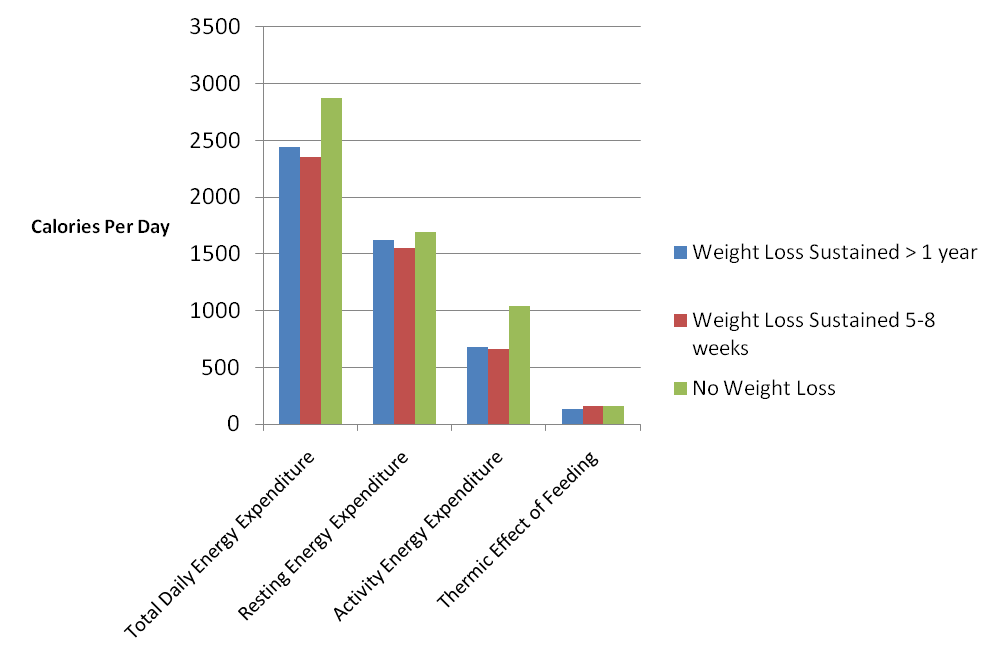
Energy Expenditures of Subjects Who Lost Weight and Who Didn't Lose Weight
You can see that the resting metabolic rate of the subjects who lost weight were slightly lower than the subjects who had never lost weight, despite the fact the subjects were of similar weight. The difference amounted to 72 - 139 calories per day. The difference in activity energy expenditure was much more dramatic, coming in at 366 - 383 calories per day. These differences in resting metabolic rate and activity energy expenditure led to a difference in total daily energy expenditure of 428 - 514 calories per day. TEF was not affected by weight loss.
When the observed energy expenditures were compared to the values predicted by the equations, the results were similar:
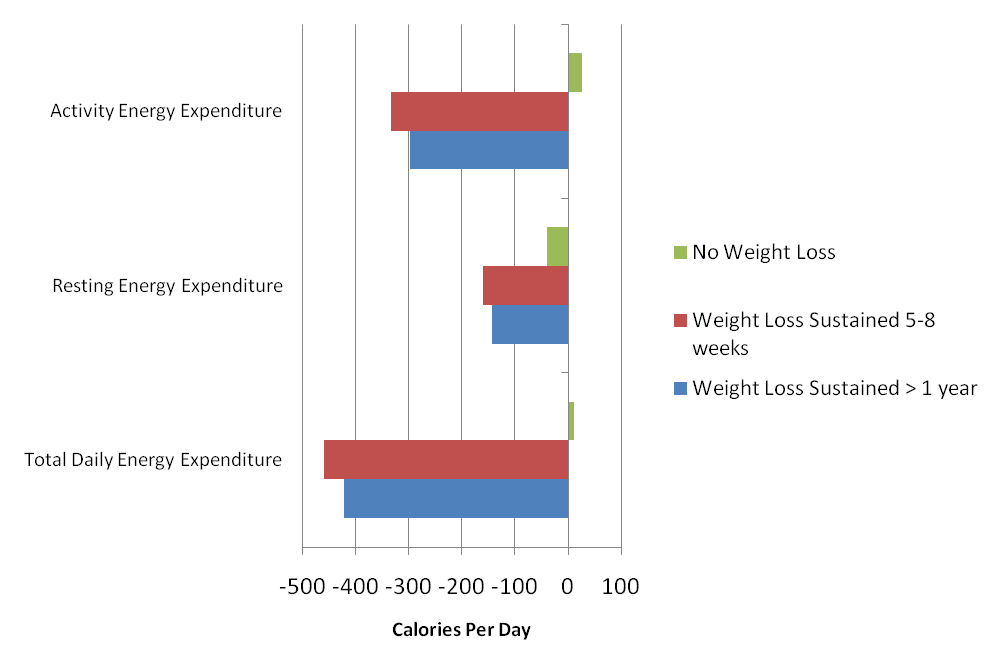
Differences between observed energy expenditures and the predicted energy expenditures for subjects who lost weight and who didn't lose weight. You can see that the energy expenditures for the subjects who lost weight were lower than you would predict, but the energy expenditures for the subjects who had never lost weight were very close to what you would predict. This indicates adaptive thermogenesis with long-term weight loss.
You can see that the energy expenditure values were lower than predicted for the subjects that lost weight, but were similar to predicted for the weight-matched subjects that had never lost weight. For REE, values were 143 to 161 calories lower than predicted in the subjects who had lost weight. This indicated a slight lowering of metabolic rate that is sustained even when the weight loss is maintained for more than a year. Where weight loss had the biggest impact was on activity energy expenditure, with values being 298 to 334 calories lower than predicted. Total energy expenditure was 422 to 460 calories lower than predicted in the weight loss subjects.
A NEAT, Efficient Explanation
It is clear from this study that metabolism (in terms of resting metabolic rate) slows with weight loss, and this decrease is greater than you would expect with the amount of weight lost. This decrease is present even when someone has maintained weight loss for more than a year. However, the slowdown of metabolic rate is not the primary culprit for why it's so easy to regain weight, as the slowdown in metabolic rate only amounts to around 150 calories per day.
The main reason why we have a greater-than-expected decrease in energy expenditure with weight loss is because we become less active. This doesn't mean we exercise less, either, as exercise is a conscious choice. It means we unconsciously reduce our NEAT and spontaneous activity. It also means we become more efficient in the activity we do; we expend less calories for the same movement. In fact, 35% of the decrease in activity energy expenditure can be attributed to an increase in efficiency. Overall, we move around less, and we become more efficient at the movements we perform. Combined with a decrease in resting metabolic rate, we end up burning over 400 calories per day less than you would expect for someone of our same height, weight, gender, and body composition. This is not only why weight loss eventually plateaus, but also why weight is so easily regained.
Other research has verified that NEAT and physical activity decrease with weight loss, and that they are the primary drivers behind why energy expenditure decreases more than you would expect. In one study, obese subjects lost 23.2% of their body weight. Total daily energy expenditure was 75.7% of what you would predict, and nearly all of the energy savings were due to a decrease in activity rather than a decrease in metabolism. In fact, the decrease in activity amounted to 582 calories per day!
It has also been found that changes in activity predict the amount of weight gained over time. In one study, women were followed for a year. They were divided into maintainers (a weight gain of less than 3%) and gainers (a weight gain of more than 10%). Changes in activity energy expenditure explained 77% of the greater weight gain in the gainers.
High Physical Activity Levels Prevent Weight Regain
The good news is that, since the reductions in energy expenditure are primarily due to decreases in activity, one can make conscious choices to increase physical activity to a sufficient extent to prevent weight regain. Research has demonstrated that high physical activity levels can help with maintenance of weight loss. In one study, subjects who exercised enough to expend 1000 calories per week regained most of their weight, but subjects who expended 2500 calories per week maintained most of their weight loss. Similar results have been observed in other studies. Subjects in the National Weight Control Registry, a database of individuals who have maintained at least a 30 pound weight loss for over a year, expend an average of 2620 calories per week in physical activity.
Remember that physical activity doesn't have to include formal exercise. NEAT makes up the majority of your activity energy expenditure, and thus has the greatest ability to impact it. In fact, walking at only 1 mile per hour will double your energy expenditure over sitting. Thus, anything that you can do to accumulate physical activity throughout the day will dramatically improve your chances of maintaining weight loss over the long haul. Even small things, like parking a car further away from a destination, or taking stairs rather than an elevator, can add up if accumulated throughout the day. But because activity can decrease on an almost unconscious level, you need to make a deliberate conscious effort to get as much activity as possible in throughout your day, every day.
Thanks for the article. It seems that people who have kept the weight off for over a year show improvements in metabolic activity over those who have more recently lost the weight. I wonder if there is any evidence to suggest that this improvement continues the longer the weight remains stable at a lower level…or are those who were obese doomed to forever suffer for their corpulence?
Gary, The improvements seen on the graph are very small and not statistically significant, so the improvements after 1 year appear to be minimal. It’s difficult to say if people are, in essence, “doomed forever.” I don’t think anyone is doomed forever. However, it is very likely that a formerly obese person will always have to work harder to keep the weight off than a person who has never had a weight problem. Like a type 1 diabetic who will always need to be on insulin, someone who used to be obese will need to maintain certain habits to help… Read more »
Another great article! I always tell my overweight friends that they have a “faster metabolism” than their lean counterparts simply because their body weight alone is a burden/ extra weight to be carried around. A good example of this is a 4 cylinder Honda civic vs a Cadillac Escalade. Assuming both cars is traveling at the same speed at same distance, the heavier car with bigger engine will obviously expend more gas(energy/ calories) because if the car’s weight and because of the bigger engine.
Oh yes I also share your opinion
Great post, as always James. Thank you for your work. Everybody has made some great points here regarding the utility of regular exercise in the post-weight loss phase (i.e. the ‘maintenance’ phase). A couple of additional observations: 1) Exercise plays an important psychological role in encouraging dietary compliance; in short, people are less likely to break good eating habits when they’re also on the straight and narrow with their exercise; 2) While changes to NEAT and REE do influence the ‘energy-out’ part of the energy balance equation (and thus may contribute to weight re-gain), it is patently clear IME that… Read more »
Harry,
You make a very good point in regards to the “creep” in energy intake. This is also why physical activity helps so much with prevention of weight regain: it allows room for the “creep” to occur without affecting body weight.
This is depressing. I don’t want to have to fight inertia all my life to stay active and keep my weight down. I don’t want a part-time job to stay thin. This really really really sucks. There has got to be a way to lower the set point so that you don’t have to fight it all the time. I am not disagreeing with your post of Leibel’s findings, only suggesting that perhaps there is a way to lose weight without having a spontaneous, involuntary reduction in NEAT. I suspect that the decrease in RMR and NEAT go hand in… Read more »
TMK,
I understand that the info from Leibel’s work can be depressing. However, there is evidence that endurance exercise will increase spontaneous physical activity in rodents. This has yet to be examined in humans, but this may also be a mechanism behind how exercise helps with long-term weight loss maintenance.
LynMarie, There is tons of scientific evidence on the powerful role that NEAT plays in how resistant people are to weight gain, and it strongly supports your anecdotal observation. It’s actually a topic that I’m going to be writing a book about, and I also do a 90 minute lecture on NEAT alone. Muata, Yes, all the little things add up. By the way, I checked out your website…would love to see you get it going again. I read about your weight loss journey and I want to congratulate you on your immense transformation. CarbSane, Yes, I’ve read about how… Read more »
Totally anecdotal, but I have a soon-to-be 11 year old very lean nephew who seems very resistant to weight gain. During family celebrations, he will stuff himself with food, but afterward, when everyone else is relaxing and basically just digesting their food, he is running around like a maniac! A few weeks ago, my husband and I took him and his little sister to an all-you-can-eat breakfast buffet. My nephew ate a lot more than he would have eaten at home – we all did actually. Afterward, we wanted to visit a gift shop that was on the first floor… Read more »
Thanks again James for this very informative piece, and thank you for putting the science behind what I have suspected with my own weight loss struggles. Many a time I have successfully lost some weight with diet alone (read as trying every diet out there) and there is always this point where I feel I am struggling against my body. It always felt like this battle of my psyche vs. my physiology. Physiology often won out and I often felt like my body wanted to gain the weight back and return to what I call it’s “comfort zone.” It’s insanely… Read more »
Gosh the results from that study are depressing! I don’t know how much you read around the LC webosphere, but exercise is almost a 4 letter word to some. Many brag how they lost weight w/o exercising. (Full disclosure here: I did no formal exercise during my weight loss, but not by deliberate design). And yet exercise is the best way to counter the reductions on the “out” side of the energy equation. I blogged on a study a while back that was rather interesting: http://carbsanity.blogspot.com/2010/04/effects-of-aerobic-exercise-and-dietary.html This study compared two diets (LC & LF) and exercise (3X 45min @60% max)… Read more »
James, Great post! As someone who has lost a significant amount of weight, I could not agree more with what you’ve said here. Whenever I had issues with plateaus or my weight starting to increase, it was almost always because I was no longer as active, and, as you pointed out, this is not necessarily exercising less. Something as simple as moving to a single level house from a house that had pretty steep stairs affected my over TDEE even though I continued to follow my usual training routine. What’s also funny is that the tips you give to move… Read more »
Something as simple as moving to a single level house from a house that had pretty steep stairs affected my over TDEE even though I continued to follow my usual training routine Even though I don’t have a very active job, I noticed a distinct difference during a period where I worked from home (and now when I’m not formally working). Those little walks to and from the car and just prepping for the public may not amount to much taken separately, but they sure do add up. Lately at home I’ve taken to running up the stairs any time… Read more »
No, it doesn’t sound silly at all. I’m a teacher, and I feel sorry for my students because I pace back and forth as I teach. I take the stairs 99.9% of the time, and I’ve been parking in pretty much the same spot for over five years. So, you’re right about how it all adds up …
Wow, phenomenal entry James, THANKS!