

Training Frequency for Hypertrophy: The Evidence-Based Bible
Key Takeaways
- When examining variables like myofibrillar protein synthesis recovery, muscle damage recovery, strength recovery, and total work recovery, it would suggest an ideal training frequency per muscle group would be between 1.5 and 2 days per week. However, such data is limited by the fact that subjects are often unaccustomed to the training protocols, which would increase muscle damage (due to the lack of repeated bout effect) and likely prolong the recovery period. Once an individual becomes accustomed to a training protocol, the recovery period is likely shorter.
- Updated meta-analytic data show little difference in hypertrophy with frequencies ranging from 1 to 6 days per week on a volume equated basis. However, most of these studies involved low to moderately-high session volumes (<12 sets per session). When session volume gets very high (15+ sets per session), evidence favors splitting the volume into more frequent sessions.
- Evidence slightly favors a frequency of 2+ days per week versus 1 day per week, especially if training volume is high.
Practical Application
- Since frequency likely plays a very minor role in hypertrophy on a volume equated basis, it is likely best to choose a frequency that works best for you, your recovery abilities, your schedule, and which allows you to train with sufficient quality volume.
- One exception is the use of the "bro-split" involving very high per session volumes (like 15-20+) performed once per week. Evidence indicates that this style of training is inferior, since there appears to be a limit to how much hypertrophy can be stimulated in a single training session.
- Evidence is starting to mount of a maximum per-session volume of around 6-8 hard sets per muscle group on average when using long rest intervals. The limit may be approximately double this with short-rest intervals. These upper limits are based on averages and individual upper limits may vary substantially from these, with some individuals needing higher levels. Overall, though, when per-session volumes start to get high (>8-10 sets), it may be better to split the weekly volume up to a greater frequency.
- Frequency can be used as a tool to manipulate weekly volume, allowing you to perform more high quality hard sets. For example, if you're doing 8 sets twice per week (16 weekly sets) and want to increase to 24, it is best to add an additional training day rather than increase the volume in each session.
TABLE OF CONTENTS
- Introduction
- Variables related to ideal training frequency
- Research on training frequency and hypertrophy (UPDATED OCTOBER 2018)
- Studies on the impact of training frequency on muscle gains (UPDATED JULY 2019)
- An updated meta-analysis
- Meta-analysis results
- Meta-regression results
- The volume-frequency interaction (UPDATED JULY 2019)
- Key Conclusions from the Meta-Analyses
- Differences from Greg Nuckols's meta-analysis
- Other frequency studies
- Coming to consilience
Next to "How many sets should I do?", one of the most common questions by people looking to maximize muscle hypertrophy is, "How often should I train each muscle group?" You'll find a variety of opinions on this matter, both among the "bros" as well as professionals in the field. In practice, you'll see training frequencies ranging from the classic "bro-split" of one muscle group per day, to the typical "train each muscle group 2-3 times per week", to the recent trends towards high training frequencies, training each muscle group on almost a daily basis. So which approach is correct? Or does it matter that much? In this evidence-based guide, I will go over all of the data that is relevant to training frequency, including muscle protein synthesis, strength recovery, muscle damage, and studies that have examined the impacts of frequency on hypertrophy. I'll also present to you a new meta-analysis on this topic, and, similar to the Set Volume Bible, I'll see if we can come to some sort of consilience on all of the available evidence.
Muscle Protein Synthesis
Some of the recommendations that you see out there regarding training frequency revolve around the muscle protein synthesis response to training. Remember that resistance training stimulates protein synthesis, the process by which your muscles build new protein. When this process of protein synthesis exceeds the rate of protein breakdown, your muscles grow. The elevation in protein synthesis happens very quickly after a training session, with most research showing it to peak anywhere in the 5 to 24 hour period after a training session. This means that your muscles have started the process of growth within hours after a session, and this process continues at least for the next day, if not longer. One concept behind an "ideal" training frequency would be to train your muscles again as soon as this process has stopped. Thus, you give your muscles a "shot" of protein synthesis every time they're done building new protein.
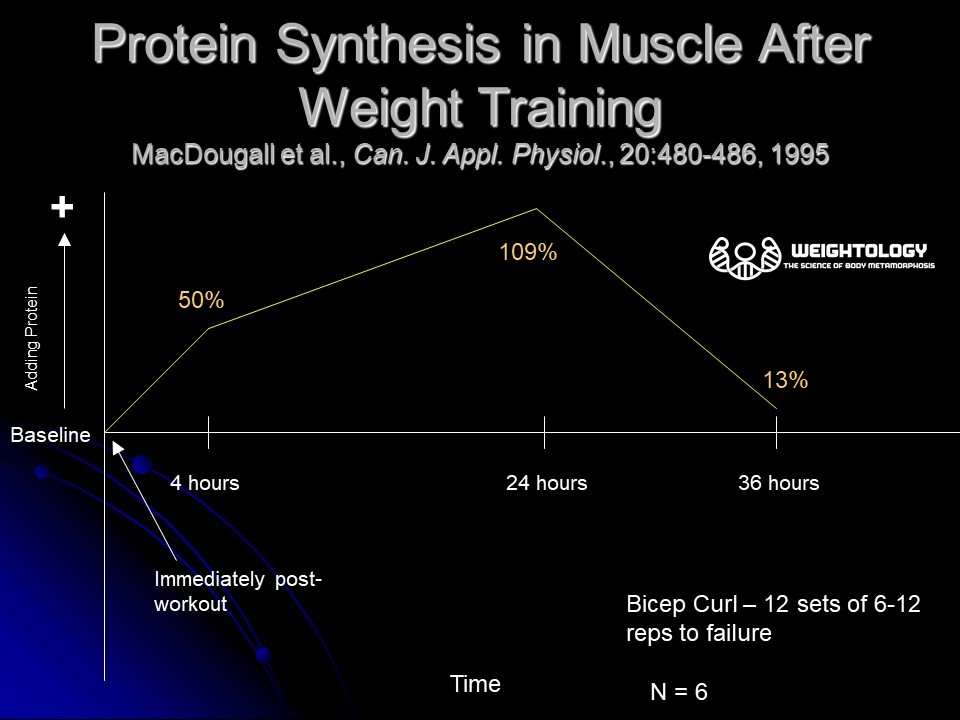
So how long does it take for this process to stop? In one study on trained subjects, subjects did 12 sets of 6-12 RM of biceps curls. Mixed muscle protein synthesis peaked at 24 hours, being elevated at 109%, but at 36 hours, was nearly back to normal, being elevated by only 13%.
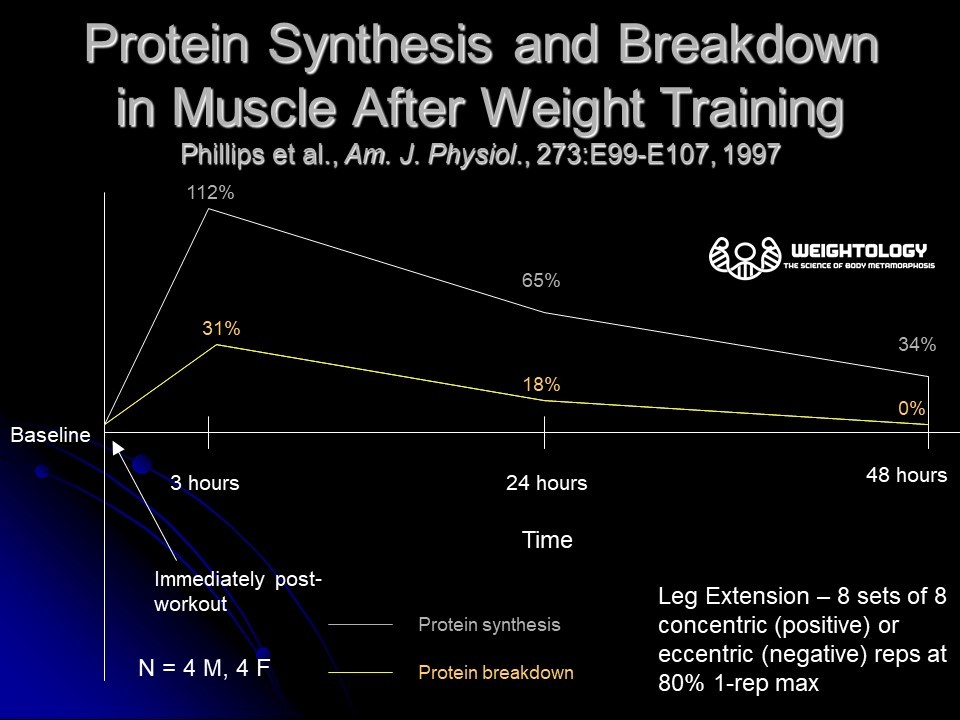
In another study on untrained subjects, mixed muscle protein synthesis was found to peak at 3 hours after a session, and was still elevated by 34% at 48 hours. This was after 8 sets of 8 concentric or eccentric-only repetitions.
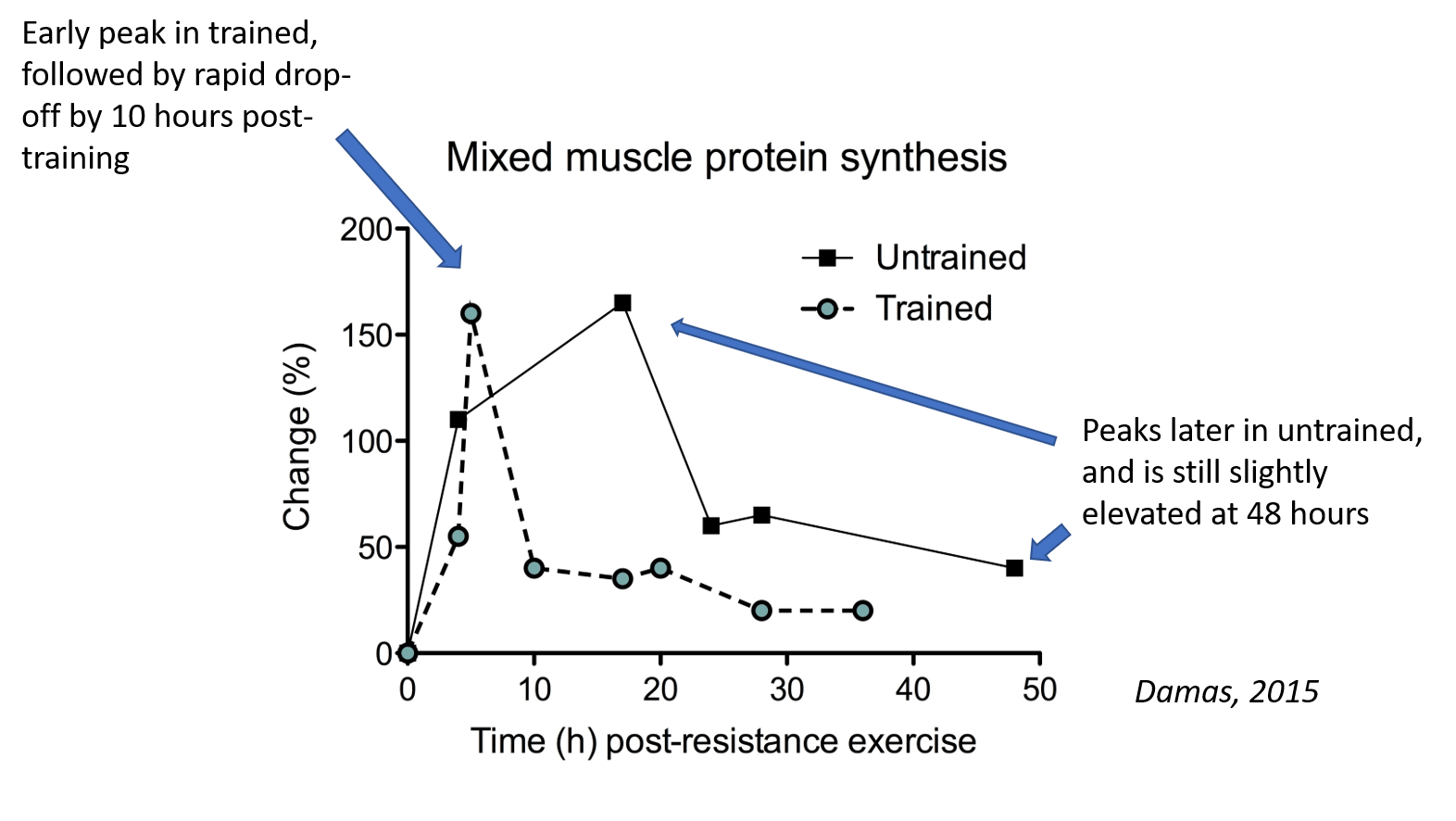
If you were to base training frequency off of this data, it would suggest that untrained individuals would want to train each muscle group every 3rd day or so, and trained individuals would want to train each muscle group every other day. In fact, these data on muscle protein synthesis response have led to some professionals believing that well trained individuals should train each muscle group on almost a daily basis, given that mixed muscle protein synthesis rapidly spikes early after each training session, and returns relatively quickly to baseline. These differences in responses are shown here in a chart from Damas and colleagues in a 2015 review paper.
However, here's the problem with trying to base training frequency recommendations off of this data. All of this research is on mixed muscle protein synthesis, which includes ALL muscle proteins, such as mitochondria, sarcoplasmic proteins, etc. However, many of these proteins don't contribute to actual muscle growth. What we really care about is myofibrillar protein synthesis, which is the creation of the proteins that form muscle fibers. In fact, the following chart shows why it's misleading to look at mixed muscle protein synthesis. In this study, trained subjects did 4 sets to failure with 90% 1-RM or 30% 1-RM on the leg extension. When examining mixed muscle protein synthesis after feeding, there was no difference between resting levels of protein synthesis (no exercise) and protein synthesis 24 hours after training. However, myofibrillar protein synthesis was significantly elevated 24 hours after training compared to resting levels.
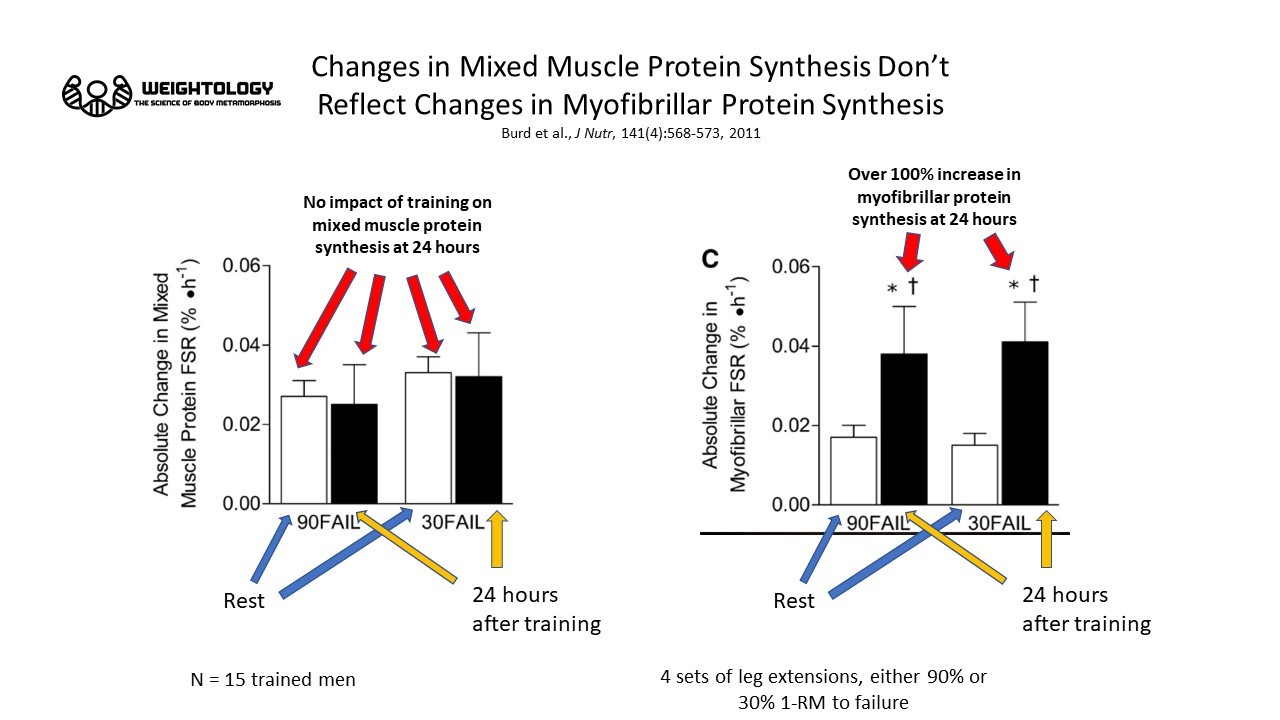
What this data indicates is that we cannot rely on the mixed muscle protein synthesis curve to help us establish training frequency recommendations. Instead, we need to focus on myofibrillar protein synthesis. It is clear from the chart above that myofibrillar protein synthesis is elevated at 24 hours in trained subjects performing moderate session volume (4 sets to failure). Other research, which I discussed in the volume bible, has also shown 3 sets to failure to result in an elevation in myofibrillar protein synthesis at 29 hours after training. Only a low volume, 1-set session resulted in a return of myofibrillar protein synthesis to baseline the next day.
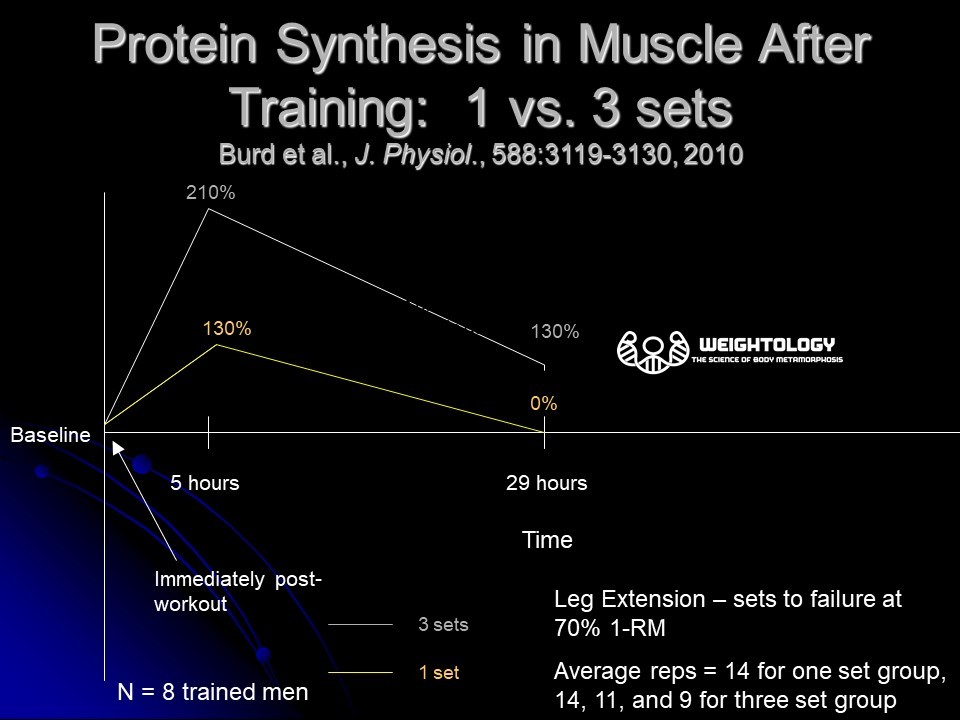
If we assume that it is best to wait until the protein synthesis response has returned to baseline before we work a muscle again, then this would suggest that training each muscle group on a daily basis may not be an ideal approach, unless session volume is EXTREMELY low (such as 1 set to failure). Of course, it may not be a fair assumption that you need to wait for the protein synthesis response to return to normal; perhaps there is another spike in protein synthesis if you train the same muscle group the next day. Unfortunately the protein synthesis response to back-to-back training sessions has not been investigated.
What this data also shows us is that it's misleading to differentiate between trained and untrained subjects based on the mixed muscle protein synthesis response. Thus, the recommendation by some that trained individuals should train more frequently, because muscle protein synthesis doesn't last as long, isn't supported by the myofibrillar protein synthesis data. In fact, as shown in this review paper by Damas and colleagues, the time course for myofibrillar muscle protein synthesis may be more similar between trained and untrained subjects than the mixed muscle protein synthesis data would suggest. The duration of the response appears similar; it's just that the magnitude of the response is lower in trained subjects.
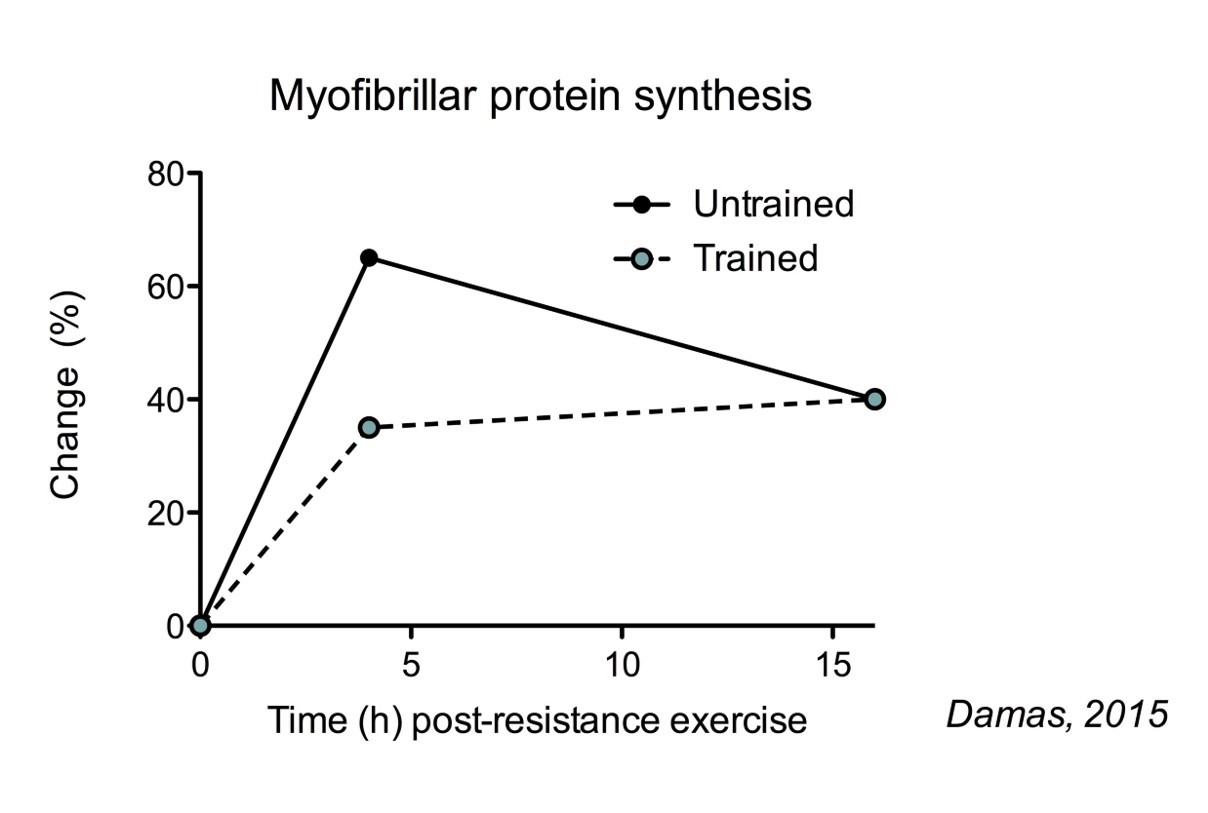
Myofibrillar protein synthesis (the protein synthesis that really matters) has a higher peak in untrained individuals, but otherwise the time course over the next 24 hours is similar between trained and untrained
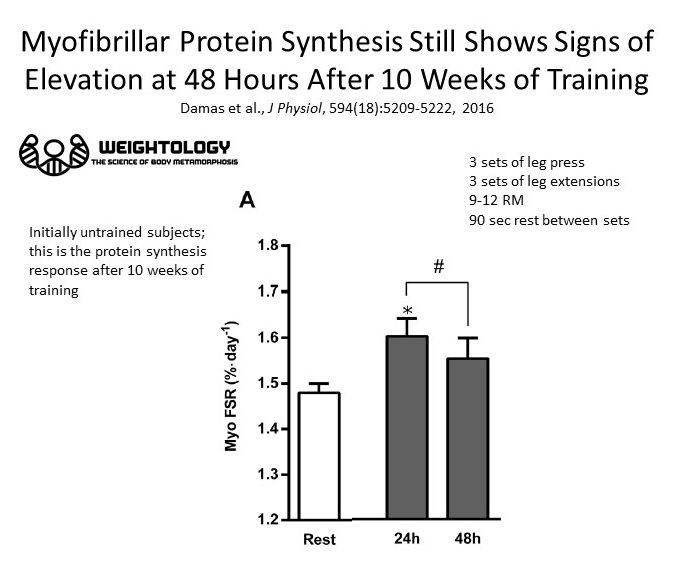
This then brings about the question: how long does the myofibrillar protein synthesis response last after a training session? I've shown you two studies that show it's elevated at 24-29 hours, but what about beyond that? Unfortunately the data is limited. In this study, untrained subjects were put on a 10 week training program. They did 3 sets of leg press and 3 sets of leg extensions two times per week, for 9-12 reps to failure on each set. At the end of the 10 weeks, myofibrillar protein synthesis was still elevated at 48 hours as compared to typical resting levels. This would suggest that, in subjects who have been training for at least 10 weeks, elevated muscle protein synthesis is still continuing at 48 hours after a session of moderate volume. This response is NOT due to muscle damage, as most muscle damage had been attenuated at 10 weeks.
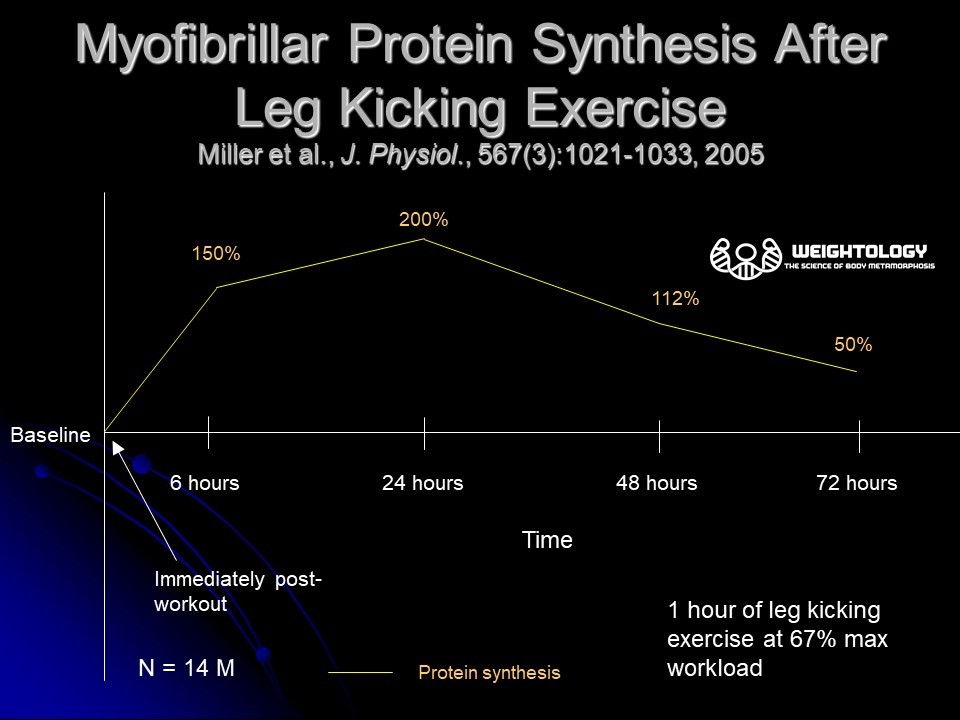
 Some research has shown myofibrillar protein synthesis to continue up to 72 hours after exercise. In this study, subjects did one hour of one-leg kicking exercise (35 kicks per minute) at 67% of their max workload. While this is more of an endurance exercise study rather than a resistance training study, the exercise did not cause any muscle damage, and yet promoted a significant increase in myofibrillar muscle protein synthesis within 6 hours after the session, peaking at 24 hours at 200% over resting levels. Protein synthesis was still elevated by 50% 72 hours later. The training status of the subjects was not identified. Despite this study not being a resistance training study, it suggests that myofibrillar protein synthesis can continue for up to 72 hours after submaximal exercise, and thus the same is likely true after resistance training of a sufficient volume.
Overall, the takeaway points from the data on muscle protein synthesis are as follows:
- Mixed muscle protein synthesis is not a reliable metric for assessing when the process of building new muscle after a training session has stopped. Myofibrillar protein synthesis is what really matters.
- Myofibrillar protein synthesis data indicates that there is a sizeable increase in muscle protein synthesis after a session of moderate volume (3-4+ sets to failure). This increase peaks within hours after a session, but remains significantly elevated for 48 hours.
- There is some evidence that myofibrillar protein synthesis may continue for 72 hours after a session, but the data is speculative at this point.
- Trained subjects have a lower peak of muscle protein synthesis after a session compared to untrained subjects; however, there does not appear to be any difference in the overall time course. More data is needed here.
The myofibrillar protein synthesis data is consistent with the common recommendation to train each muscle group 2-3 times per week. This is if you train each muscle group to failure with at least 3-4 sets per session, and if you wanted to wait for the muscle protein synthesis response to be finished before you trained a particular muscle group again. Of course, as I mentioned earlier, perhaps you don't need to wait for the response to come back to baseline before you train again, but there is no data on this.
It's also important to remember that muscle protein synthesis is only one aspect of recovery. Just because the muscle protein synthesis response has slowed down, doesn't mean you are fully recovered from a previous session. There are other aspects of recovery, including markers of muscle damage, strength, and the total amount of work you can perform of an exercise. Let's look at these aspects.
Recovery of Muscle Damage
When you perform unaccustomed exercise, you cause muscle damage, which is responsible for the soreness you feel after a training session. As you continue to train over weeks, you get less and less sore; this is because your muscles have become more resistant to damage (the repeated bout effect). This repeated bout effect happens fairly quickly; for example, within 3 weeks of training legs twice per week (6 sets per session), signs of muscle damage after each session are dramatically reduced. However, this does not mean that, if you are well trained, that you do not incur any muscle damage from each session. When training with moderate to high levels of volume, even trained subjects will show some signs of muscle damage after a session. However, this should be interpreted with caution, as even trained individuals can be unaccustomed to the protocol used in a research study. It is likely, with repeated bouts of a high enough frequency, that muscle damage would be reduced.
So how long does it take for muscle damage to recover? Here's a summary of some of the research in this area. Most of these studies are on trained subjects.
- In this study, untrained men and women performed 8 sets of 10 RM of preacher curls. Muscle swelling and self-reported muscle soreness were still elevated 4 days after the session; measurements were not made beyond 4 days. In a similar study, untrained women performed 4 sets of 10 repetition with 80% 1-RM on the curl. Muscle soreness, swelling, and damage were still elevated after 4 days.
- In this study, trained subjects showed little sign of muscle disruption after 5 days of recovery from their usual training routines.
- In this study, trained subjects did 3x3 RM of squats, 3x3 RM of front squats with 6 minute rests, and 3x6 RM of leg extensions with 4 minute rests. Blood levels of creatine kinase, a very rough indicator of muscle damage, remained elevated up to 33 hours after the session. Interestingly, creatine kinase was elevated when the men did 70-76% of the loads of the heavy session (sets were not taken to failure; they did the same repetitions with ligher loads); it peaked at 11 hours, and was nearly back to baseline after 33 hours. However, it should be noted that blood level of creatine kinase is a very insensitive indicator of muscle damage. There was no relationship between markers of muscle damage and markers of contractile function (like peak torque).
- In this study, trained subjects did 3x6 RM of squats, front squats, and leg extensions for a total of 9 sets. This was preceded by warm-up sets of 5 sets of squats, 4 sets of front squats, and one set of leg extensions with progressively heavier loads. Rest between sets was 3 minutes. Creatine kinase was elevated for up to 29 hours after the session, although changes were not statistically significant due to the very high variability in responses from one person to the next. Measurements were not done beyond 29 hours.
- In this study, trained men did 8 sets of bench press to failure, starting with a weight of 90% of 10-RM. Soreness was significantly elevated for 72 hours after the session, and was back to near baseline at 96 hours.
- In this study, trained men did 5 sets of 12 RM with 50 seconds rest of leg press and leg extension at either a slow or fast velocity. Thigh circumference was used to estimate muscle swelling. In the slow velocity group, thigh circumference was not back to baseline until 96 hours, and in the fast velocity group, it was still elevated.
- In this study, trained subjects did 3 sets of 10 RM of bench press and squat. Creatine kinase was elevated for 48 hours after the session, and returned to baseline at 72 hours.
- In this study, trained men did 5 sets of 10 RM in leg press and 4 sets of 10 RM in squats with 2 minute rests. Creatine kinase, muscle soreness, and muscle swelling were all elevated at 48 hours after training; measurements were not made beyond that time point. Interestingly, subjective perception of muscle fitness, which was measured out for a week and likely correlates with muscle soreness, had returned to baseline on day 4, and was above baseline on day 6 (indicating subjects felt they had improved in muscle fitness on day 6 over baseline).
- In this study, trained men did a whole body session that consisted of 4 sets of 10 RM of chest press, pullover, biceps curl, triceps extension, leg extension, and leg curl. Creatine kinase levels and lactate dehydrogenase levels (another rough blood marker of muscle damage) were still elevated at 72 hours after each training session. Similar results were observed in a study of untrained men that did 3 sets of 80% 1-RM of bench press, lat pull, shoulder press, tricep extension, and bicep curl. A third study on trained men showed creatine kinase to elevated up to 72 hours after a session, and it recovered back to baseline at 168 hours (no measurements were made between 72 and 168 hours). In that study, subjects did a whole body workout involving 3 sets of 10 RM of chest press, lat pull, bicep curl, triceps extension, leg extension, and leg curl. A fourth study on untrained subjects, performing 4 sets of biceps curls to failure using 85% 1-RM, showed creatine kinase elevated up to 96 hours after a session, and self-reported muscle soreness was still elevated at this point.
When considering recovery from weight training, we need to take account for the repeated bout effect. When you first perform unaccustomed exercise that has a significant eccentric component (like weight training), it can cause significant muscle damage. After only one session, the muscle produces adaptations that make it more resistant to damage the second time around. This is known as the repeated bout effect. The repeated bout effect impacts the rate of recovery from muscle damage. For example, in this study, untrained subjects did 5 sets of 6 reps of curls. After the first session, maximal voluntary isometric force was not recovered even after 96 hours. However, after the second bout, it was recovered within 24 hours. Range of motion (which can be a marker of muscle swelling and tissue damage) was still not back to normal after 96 hours after the first bout, but was back to normal after 72 hours with the second bout. Muscle soreness was elevated continuously out to 96 hours after the first bout, but was back to normal after 72-96 hours with the second bout. These recovery markers would likely improve further with more repeated bouts.
Recovery may vary between different types of exercises (such as single joint versus multijoint). In this study, trained men did 8 sets of 10 RM of seated rows or preacher curls. Self-reported soreness was significantly higher after the preacher curls compared to the rows at both 24 and 48 hours. At 72 hours, soreness was still significantly elevated after the preacher curls but not the rows. However, again this is an instance where statistical comparisons of group averages may be misleading. While the difference was not statistically significant, the mean value after rows was not close to baseline until 96 hours, and after curls, there was still a slight elevation at 96 hours even though it was not statistically sigificant. Unfortunately individual data was not reported. If we use soreness as a proxy for recovery of muscle damage, this data would suggest that it can take up to 96 hours or more to recover from 8 sets to failure.
The following table summarizes all of the research on recovery of markers of muscle damage after resistance training.
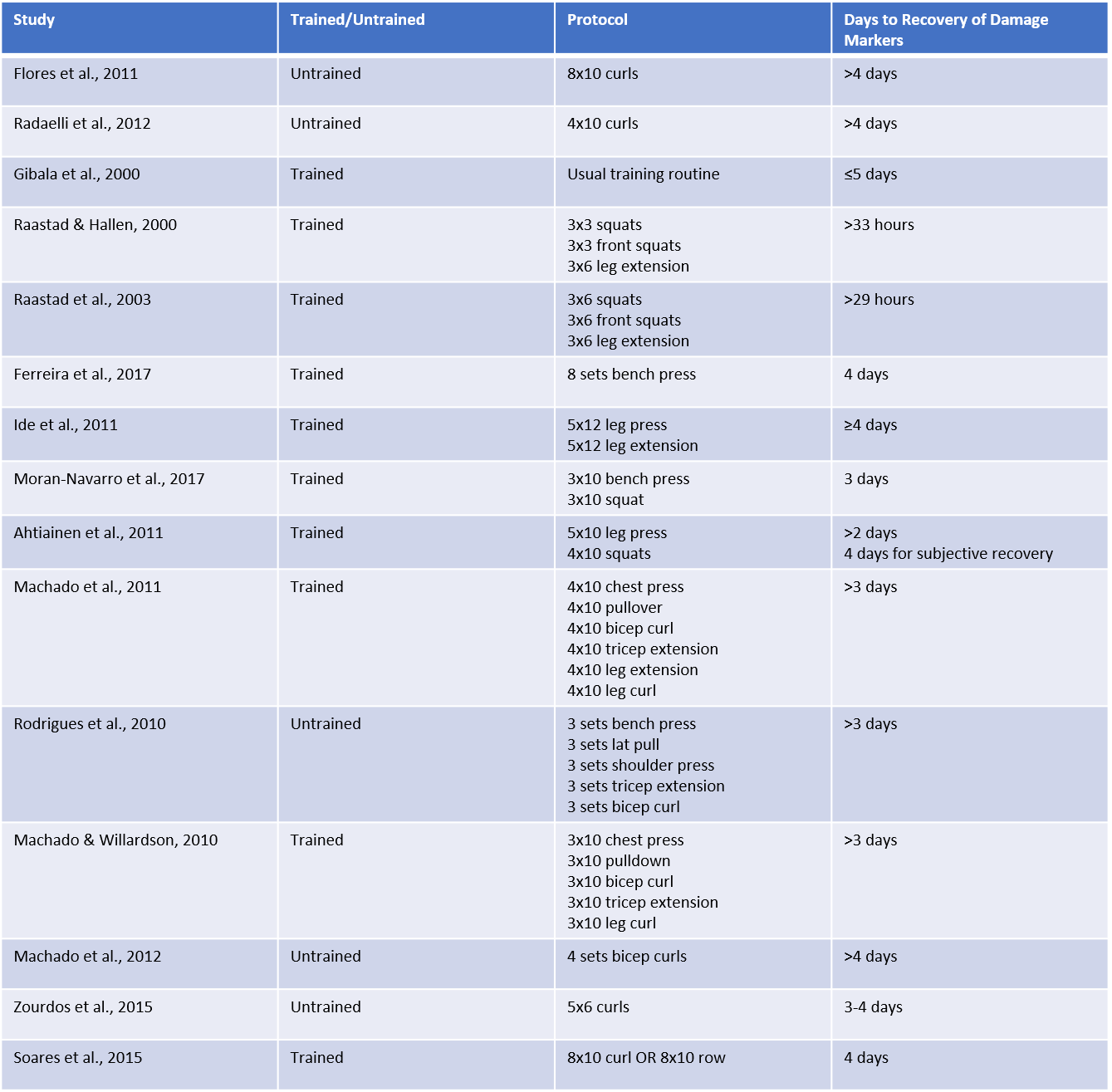
Overall, the research indicates that it can take 4 days or more to recover from muscle damage from a single training session of moderate to high volume, even in trained subjects. This would suggest a training frequency for each muscle group of once every 4-5 days, or approximately 1.5 to 2 times per week if we use markers of muscle damage as an indicator of when to train again. This assumes you are training with a moderate to high volume for each session (3-4 sets or more), and taking all sets to failure or near failure. Of course, this also assumes that you need to wait until muscle damage is fully recovered before you train again, which may not be a valid assumption. However, this has not been well studied. We could guess that, if you did repeatedly train before damage was fully recovered, you would only do so for short periods of time before embarking on a deload period to allow for full recovery.
Of course, there is a big limitation to this conclusion. Even in the studies on trained subjects, the subjects are generally not accustomed to the training protocol. Trained subjects can still experience muscle damage and muscle soreness when doing a new exercise, or a new higher training volume, and/or if they train with a low frequency. This would prolong the recovery period. With repeated bouts of the same protocol, muscle damage should be reduced, especially if the frequency is moderate to high (2-3 times per week). Thus, the suggested frequency of 1.5-2 times per week may in fact be higher with repeated bouts, as the rate of recovery should be improved.
Recovery of Maximal Force Production
Another marker of recovery that we can examine is recovery of force production. There's been a number of studies that have examined recovery of force production after a resistance training session. Here's a summary of them:
- In this study, subjects with resistance training experience performed either 5 sets of 3 RM with 3 minute rests, or 3 sets of 12 RM with 1 minute rests on the leg extension. Maximal isometric voluntary contraction force (MIVC) of the quadriceps was mostly recovered by 6 hours in both groups. However, MIVC may not reflect dynamic muscle performance (such as 1-RM leg extension).
- In this study, trained subjects did 3x3 RM of squats, 3x3 RM of front squats with 6 minute rests, and 3x6 RM of leg extensions with 4 minute rests. Peak torque at two different velocities for leg extension was recovered by 33 hours. One limitation of this study is that isokinetic peak torque (where the speed of movement is kept constant) may not be the same as dynamic force production using a constant external load (which is how most people train with weights). The subjects repeated the experiment using 70-76% of the loads they used for the heavy session, and peak torque was recovered within 5 hours.
- In this study, trained subjects did 3x6 RM of squats, front squats, and leg extensions for a total of 9 sets. This was preceded by warm-up sets of 5 sets of squats, 4 sets of front squats, and one set of leg extensions with progressively heavier loads. Rest between sets was 3 minutes. Isokinetic peak torque was recovered by 29 hours.
- In this study, trained subjects performed a whole body resistance training workout that consisted of 7 compound movements, including two different types of squats, bench press, rows, snatch, pull-ups, and hang cleans. Most exercises were performed with either 4-6 RM or 10-12 RM; sessions took about an hour. Maximal voluntary isokinetic torque was not recovered until 48 hours later.
- In this study, untrained women performed 5 sets of 10 RM of the leg press with 3 minutes rest between sets. After 48 hours, maximal force production still had not fully recovered, being at 91-94% of baseline levels.
- In this study, untrained men and women performed 8 sets of 10 RM of preacher curls. Isokinetic peak torque of the biceps was still not recovered after 4 days. Measurements were not made beyond day 4. In a similar study, untrained women performed 4 sets of 10 repetition with 80% 1-RM on the curl. Isometric peak torque of the biceps was still reduced 4 days later.
- In this study, trained men did 5 sets of 10 RM in leg press and 4 sets of 10 RM in squats with 2 minute rests. Isometric leg extension force was significantly reduced at 48 hours; measurements were not made beyond that time point.
- In this study, trained men did 5 sets of 12 RM of leg press and leg extension with 50 seconds rest at either a slow or fast velocity. In the slow velocity group, leg press 1-RM was recovered at 48 hours, but did not show any evidence of improvement until 96 hours. The fast velocity group was not statistically back to baseline until 72 hours, although the overall mean was still slightly reduced, and full recovery was not evident until 96 hours.
- In this study, trained subjects did 3 sets of 10 RM of bench press and squat. Mean propulsive velocity and countermovement jump height (metrics of performance against various loads) were all reduced for 24-48 hours after the session. Statistically all performance metrics were not significantly different from baseline at 72 hours, although some of the mean values suggested some slightly depressed values in some subjects.
Recovery may vary between different types of exercises (such as single joint versus multijoint). In this study, trained men did 8 sets of 10 RM of seated rows or preacher curls. Peak isometric torque in the biceps was significantly reduced at 24 hours after the preacher curls, but not the rows. Both were not significantly different from baseline at 48 hours. However, again this is an instance where statistical comparisons of group averages may be misleading. While the difference was not statistically significant, the mean values for both the rows and preacher curls were still lower than baseline at 48 hours, indicating there were still likely a fair number of subjects who had not recovered at 48 hours. In fact, mean isometric force production was not comparable to baseline until 96 hours. Unfortunately individual data was not reported.
The following table summarizes all of this research on recovery of force production after training.
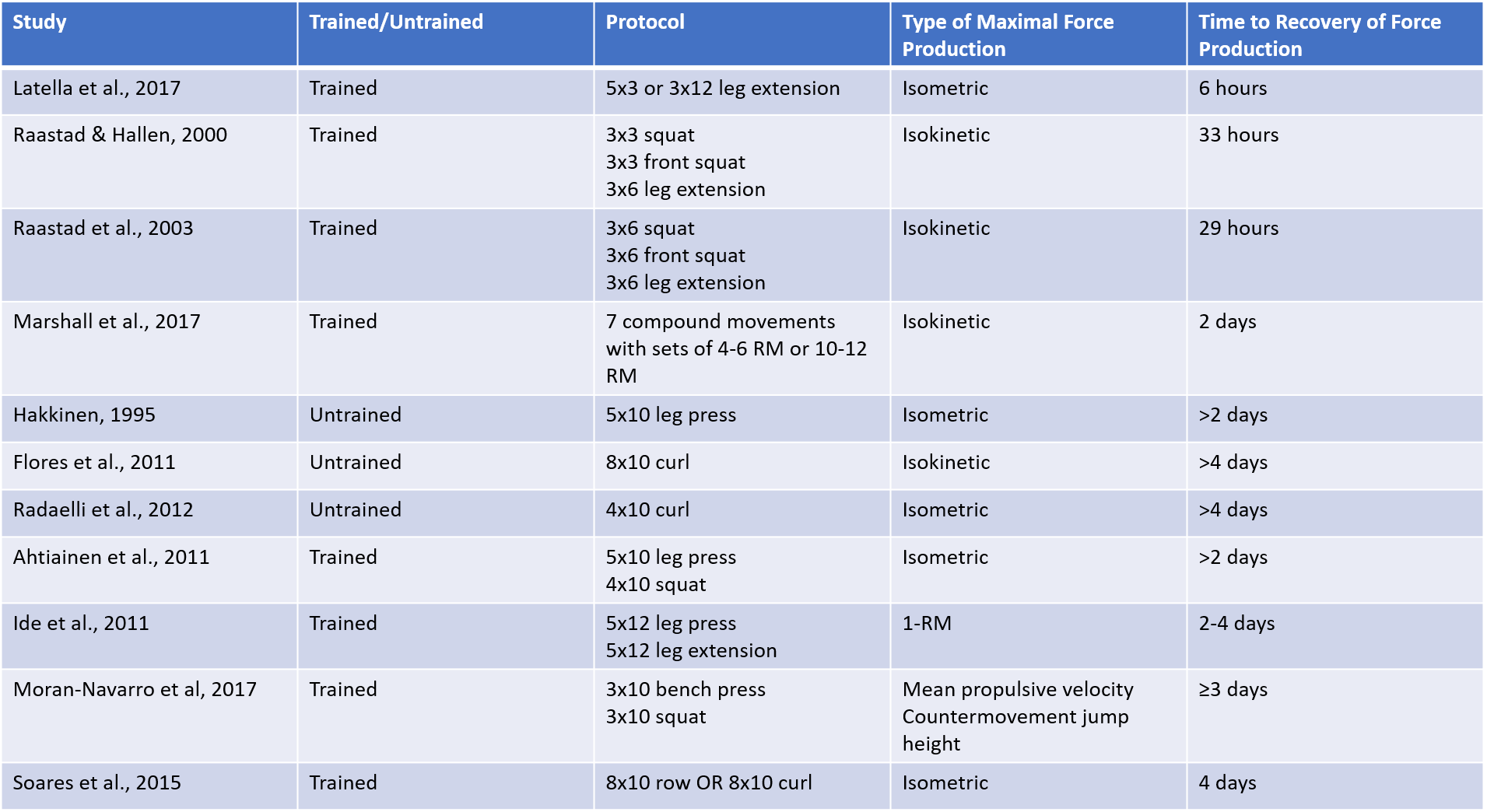
Overall, most of the data suggests that it takes 3-5 days to recover metrics of force production after training with a moderate to high volume in a training session. This is similar to the data on muscle damage discussed earlier, and, like that data, suggests training each muscle group once every 3 to 5 days, or 1.5 to 2 times per week. This assumes you want full recovery of force production before training again; this may not be a valid assumption, as there could be benefits to short periods of training where you do not fully recover from one session to the next. However, training this way would require deloads at some point; otherwise, the accumulated fatigue would eventually result in an overtrained state.
Similar to the data on muscle damage, there is a big limitation to this conclusion. Even in the studies on trained subjects, the subjects are generally not accustomed to the training protocol. Trained subjects can still experience a significant reduction in force production when doing a new exercise, or a new higher training volume, and/or if they train with a low frequency. This would prolong the recovery period. With repeated bouts of the same protocol, the recovery rate should be improved, especially if the frequency is moderate to high (2-3 times per week). Thus, the suggested frequency of 1.5-2 times per week may in fact be higher with repeated bouts.
Recovery of Total Work
One of the problems with studies that look at peak torque as a marker of recovery is that it may not match up with the recovery of the ability to perform multiple sets and reps of an exercise. In a study on trained men, subjects did 8 sets of bench press to failure, starting with 90% of 10-RM. Peak torque for shoulder horizontal adduction (drawing the arm across the body, as in a cable crossover, so it's a marker of chest and anterior deltoid force production) remained significantly lower than baseline up to 72 hours, and then was not significantly different from baseline at 96 hours. Total work performed with shoulder horizontal adduction was also significantly reduced; in fact, the reduction in total work as greater than the reduction in peak torque, and total work was still significantly reduced at 96 hours. Thus, this study showed that 4 days was still not enough for full recovery in trained men after 8 sets of bench press to failure, and simply looking at peak torque recovery can be misleading.
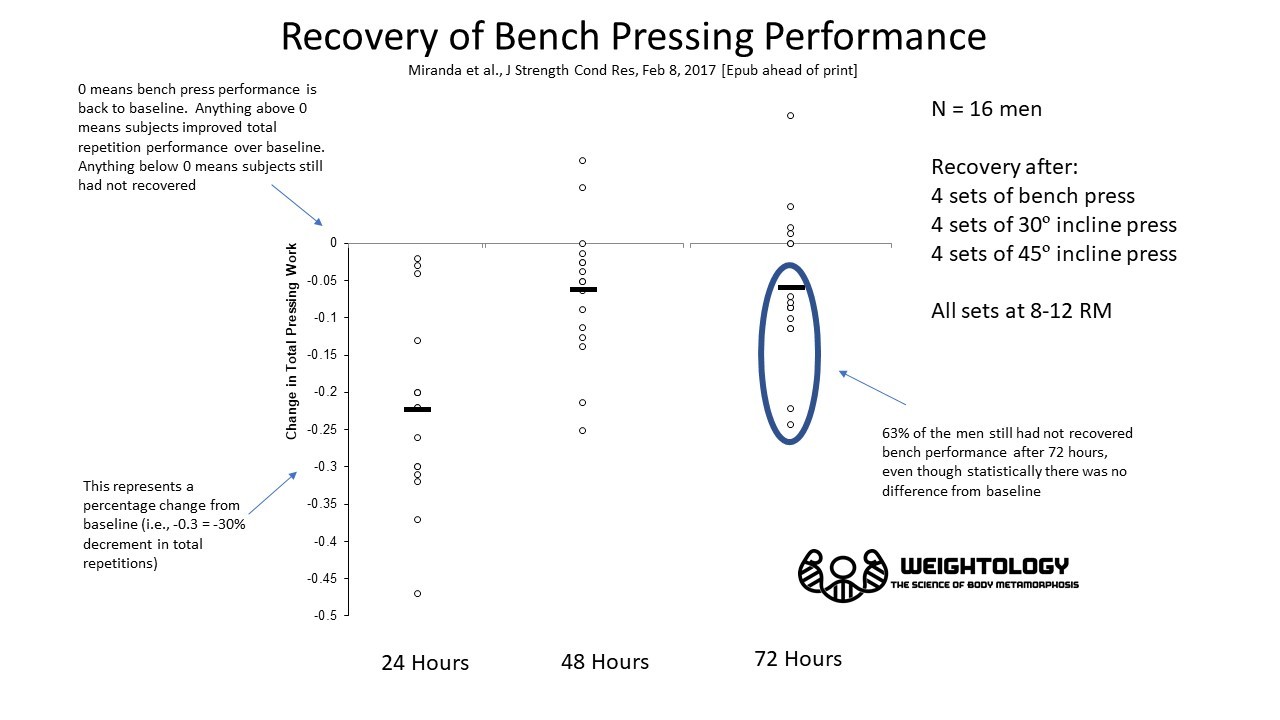
In a very interesting study by Miranda and colleagues, trained men did 4 sets of 8-RM of the bench press, and two different incline bench presses, with 2 minute rests. Thus, total pressing volume was 12 sets to failure. If you look at the group averages, total work (i.e., total repetitions across all sets) was recovered by 48-72 hours. However, this is one of those cases where looking at group averages can be misleading. At 48 hours, only 3 of the 16 men had fully recovered repetition performance (with two of those three showing an improvement), and at 72 hours, only 6 of the 16 men had fully recovered repetition performance (with 4 of those six showing an improvement). Thus, 63% of the men had still not recovered performance after 72 hours, even though there was no statistical difference between performance at 72 hours and baseline.
In this study, young (ages 18 to 30) trained subjects did 3 sets of 10 RM of 8 exercises (bench press, lateral raise, tricep extension, leg press, bicep curl, lat pulldown, leg curl, and leg extension), with 30 seconds to 1 minute rest between sets. There was quite a bit of variation between subjects in recovery. None of the subjects could reproduce their 10 RMs at 24 hours. At 48 hours, performance was not statistically different from baseline, but, similar to the above mentioned study, the average results don't tell you the whole story. At this time point, only 40% of the subjects could reproduce their 10 RM. After 72 hours, 80% of the subjects had recovered. When the researchers increased the volume to 7 sets per exercise, recovery increased to 96 hours. In this same study, older trained men (ages 50-65) were also studied. Even at 96 hours, 70% of the older men could not replicate their performance, indicating that age dramatically increases recovery time.
In this study, trained subjects did 3 sets of 10 RM of 6 exercises (bench press, tricep extension, leg press, bicep curl, lat pulldown, and leg curl), with 2 minute rests between sets. They tested recovery at 48, 72, 96, and 120 hours. They did this twice to see how stable the recovery of performance was (i.e., if it takes 48 hours to recover performance, is this true if you did the same test one week later?) At 48 hours, 70% of the subjects had recovered to baseline when considering all six exercises combined. However, recovery for individual muscle groups varied widely, and was inconsistent when the procedure was repeated. When looking at individual muscle groups, stability ranged from 20 to 70%. Thus, recovery of performance might work when assessing a bunch of muscle groups in combination, but may not be reliable when looking at individual muscle groups. A lot of factors may impact how quickly someone recovers from a training session, including things like rest and nutrition. Another unpublished study suggested that most lifters recovered performance within 48 hours, but again such research would have the same limitations.
In this study, recreationally trained men did one set of 8 reps with 85% of 10-RM, and then one set to failure with 10 RM per exercise. The exercises were bench press, deadlift, overhead dumbbell press, leg press, leg extension, machine chest fly, tricep extension, dumbbell lateral raise, and hip adduction and abduction. Subjects had 90 seconds rest between sets. Subjects were considered recovered if they were able to complete within 1 repetition of their baseline performance during the second set of each exercise. At 24 hours, 50% of the subjects met the definition of recovery, and at 48 hours, 80% of the subjects had met this definition. At 24 hours, there was a significant difference in recovery between multijoint and single joint lifts, with single joint lifts showing more recovery. This tendency still existed at 48 hours, but was not quite statistically significant (P = 0.07). When looking at the table of the percentage recoveries for different lifts, you can see the tendency for multijoint lifts to be slower in recovery than the others (particularly the bench press and deadlift).
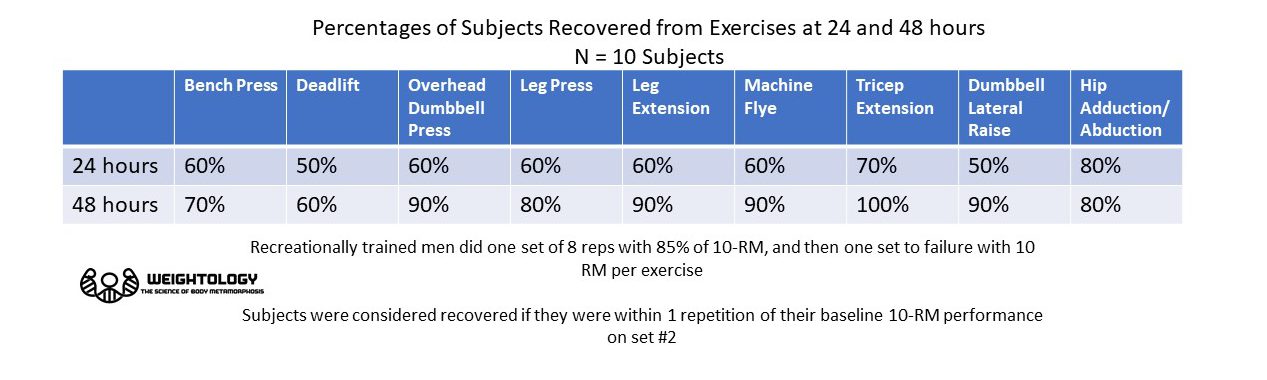
Here's the breakdown by single joint and multijoint lifts, and upper body versus lower body. You can see that recovery is slightly faster for single joint.
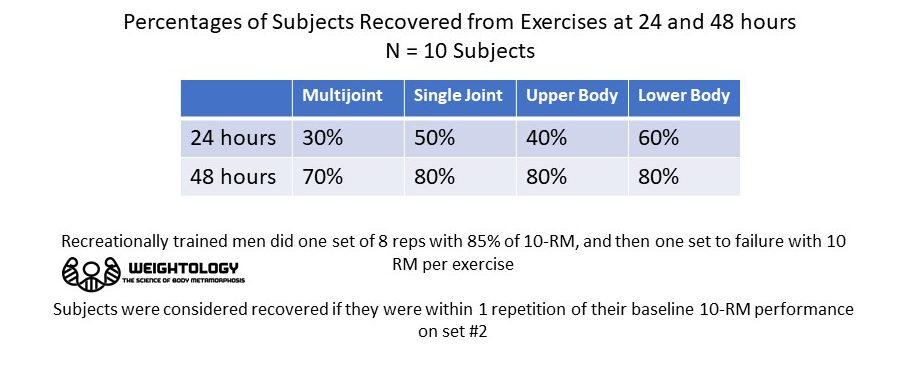
This study also shows that, in recreationally trained subjects, even a low volume of training (a few sets per exercise, with only one set to failure) requires at least 48 hours to achieve recovery in most individuals (and even then, a small percentage of subjects are not fully recovered).
The following table summarizes the research on recovery of total work from a resistance training session.

Overall, the weight of the evidence for recovery of total work indicates that lower session volumes require around 2-3 days for recovery, and higher session volumes require 4 days or more. This is similar to the data on muscle damage and maximal force production discussed earlier, and, like that data, suggests training each muscle group once every 3 to 5 days, or 1.5 to 2 times per week. This assumes you want full recovery of total work before training again; similar to other recovery metrics, this may not be a valid assumption, as there could be benefits to short periods of training where you do not fully recover from one session to the next. However, as mentioned earlier, training this way would require deloads at some point; otherwise, the accumulated fatigue would eventually result in an overtrained state.
Similar to the data on muscle damage and recovery of force production, there is a big limitation to this conclusion. Even in the studies on trained subjects, the subjects are generally not accustomed to the training protocol. Trained subjects may experience longer periods of recovery when doing a new exercise, or a new higher training volume, and/or if they train with a low frequency. With repeated bouts of the same protocol, the recovery rate should be improved, especially if the frequency is moderate to high (2-3 times per week). Thus, the suggested frequency of 1.5-2 times per week may in fact be higher with repeated bouts.
Training to Failure vs. Not Training to Failure
It is often suggested that not training to failure (such as leaving 1-2 reps in the tank) might improve recovery and allow you to train more frequently than training to failure. However, there is no research comparing training to failure to training just shy of failure on recovery. It would seem doubtful that leaving 1-2 reps in the tank would make a dramatic difference in recovery over subsequent days, especially since part of the recovery process involves repairing muscle damage, which is primarily the result of mechanical tension rather than fatigue. A single rep or two shy of failure likely would not make much of a difference in terms of muscle damage incurred, compared to training to failure.
There is some research comparing training to failure to training well short of failure on recovery, but it is limited. In this study, trained subjects did 3 sets of 10 RM, 3 sets of 5 with a 10 RM weight (5 reps short of failure), or 6 sets of 5 with a 10 RM weight (5 reps short of failure) of bench press and squat. Mean propulsive velocity and countermovement jump height (metrics of performance against various loads) were all reduced for 24-48 hours after subjects did 3 sets to failure, but these metrics were not impacted in the following days after submaximal training. After training to failure, statistically all performance metrics were not significantly different from baseline at 72 hours, although some of the mean values suggested some slightly depressed values in some subjects. Creatine kinase, an indirect and very rough marker of muscle damage, was elevated for 48 hours after the session, and returned to baseline at 72 hours. Six sets of 5 (but not 3 sets) caused an elevation in creatine kinase at 24 hours, but it was back to baseline at 48. This research showed that training to failure increases recovery time by a couple days over training well short of failure. However, it should also be noted that training well short of failure results in less muscle growth; this is likely due to inadequate stimulation of all muscle fibers. This is not to say that there is no benefit to submaximal training; I will address the potential benefits of regular periods of submaximal training in a future article.
Studies on the Impact of Training Frequency on Muscle Gains
While all of this data so far is pointing towards ideal training frequencies of training a muscle group once every 3 to 5 days, or 1.5 to 2 days per week (3 days per week if session volume is low), this is based off of extrapolation from protein synthesis data, strength/work recovery data, and muscle damage recovery data. There is also the limitation of the fact that subjects were likely not accustomed to the protocols with repeated bouts; it is likely that frequencies of 2-3 days per week or more may be better once a person becomes accustomed to the training protocol. Ultimately, we need to look at what happens to changes in muscle size when you put people on training programs with different frequencies, while controlling for weekly volume (since weekly volume can impact muscle size gains).
There have been some studies that have compared different training frequencies while equating volume, and more are continuing to be published. The results of these studies have varied, with some showing no difference between different frequencies, and others showing an advantage to a higher frequency (such as 3 days being better than 1 day). Differences in results between studies may be due to differences in study design, training program design, training frequency (studies compare a wide variety of frequencies, although most compare 1 vs. 3, 1 vs. 2, or 2 vs. 3), measurement techniques (indirect methods like body composition, or the preferable direct methods like ultrasound which are more accurate), etc. Here's a quick summary of the volume-equated studies that have been published so far.
- This study showed no difference between 2 and 3 days per week in untrained subjects (most of which were middle aged women). Lean mass was measured via DEXA; there were no direct measurements of muscle size.
- This study showed no difference between 1 and 2 days per week in untrained men. Arm circumference was measured via tape measure (a very rough, insensitive measurement of muscle size), and bicep muscle thickness was assessed via ultrasound.
- This study showed training each exercise 3 days per week resulted in greater lean mass and strength gains compared to 1 day per week in trained subjects, but training volume was extremely low (only 3 weekly sets per exercise), so it may not be applicable to higher training volumes. Lean mass was assessed via skinfolds, which have significant limitations for determining body composition; there were no direct measurements of muscle size. The results of this study do fit well with the strength/work recovery and protein synthesis data for low volumes.
- This study showed a 3-day whole body routine resulted in significantly greater bicep gains compared to a split routine, where the biceps were worked directly or indirectly 2 days per week. Tricep and vastus lateralis gains were also favored in the 3-day group, although the differences were not statistically significant (triceps were also worked directly or indirectly 2 days per week, while quads were worked once per week in the split routine group). The study was on well trained men, and muscle size was assessed via ultrasound.
- In this study, researchers compared the effects of three different training frequencies on circumference measurements in untrained men. There were no direct measurements of muscle size. In one of the groups, arms were trained once per week, while in the other two groups, they were trained twice per week. Also, in two of the groups, legs were trained once per week, while in the third group, legs were trained twice per week. There were minimal differences between the groups. It should be noted that the researchers in this study did not use the appropriate statistical procedures for the data, although this did not likely have any impact on the outcomes.
- In this study, researchers compared training each muscle group 1 day per week versus 3 days per week. Lean mass was assessed via DEXA; there were no direct measurements of muscle size. There were no differences between groups in body composition outcomes.
- In this study on untrained subjects in a weight training class, muscle groups were trained either 3 or 4 days per week. Body composition was assessed via skinfolds and changes in muscle size were assessed using circumference measurements with a tape measure. Overall there were no significant differences in changes between groups, except that chest circumference increased significantly more with 4 times per week.
- This study which I reviewed here in Weightology compared training each muscle group 2 times per week versus 4 times per week in recreationally trained subjects. Changes were assessed using the Bod Pod, circumference measurements, and ultrasound determination of muscle thickness. There were no meaningful differences between the groups.
- In this study on trained subjects, young men performed bench and squat either 3 times per week or 6 times per week. Deadlift was performed either once or twice per week. While it is not clear from the methodology, it appears that other muscle groups (like lats, arms, and shoulders) were also trained either 3 times per week or 6 times per week. Fat mass changes were assessed using A-Mode ultrasound, and thus lean mass changes were derived from the fat mass changes. Gains in lean mass and 1-RM performance were similar between the groups.
- In this study on trained subjects, young men trained 5 days per week. One group performed a bro-split routine, with each muscle group trained once per week. The other group did a whole body routine 5 days per week, so that each muscle group was trained 5 days per week. Subjects performed 10-15 weekly sets per muscle group. Body composition was assessed via DEXA. Gains in lean mass were similar between the groups.
- Brigatto and colleagues compared a bro-split, where each muscle group was trained once per week, to training each muscle group twice per week, in trained men. Weekly volume was 16 sets per muscle group. Changes in muscle size were assessed via ultrasound. There were no significant or meaningful differences in changes in muscle size between the groups, and effect sizes for each group were very similar.
- Gentil and colleagues compared training the biceps and triceps either once per week or twice per week in trained subjects (at least one year of training experience) for 10 weeks. They used a combination of compound and isolation movements; total weekly volume per muscle group was 12 sets (3 sets per exercise, 2 compound and 2 isolation for biceps and triceps). There was no significant group by time interaction for hypertrophy. However, bicep size significantly increased only in the group training once per week by 3.1%.
- Zaroni and colleagues compared whole body workouts 5 days per week, to a body part split where each biceps and triceps were trained twice per week (once directly, once indirectly) and legs were only trained once per week. Thus, the study compared a frequency of 5 days per week to 2 days per week for arms, and 5 days to 1 day for legs. Increases in bicep size and vastus lateralis (a muscle in the quadriceps) size were significantly greater in the higher frequency group. It's possible that training more frequently allowed for higher quality volume in the 5-day group, as total load volume was significantly higher. This supports the idea that the best frequency is one that allows you to train with the highest quality volume.
- In a study I reviewed here at Weightology, Tavaras and colleagues reduced their training volume from 24 weekly sets to 8 weekly sets on quadriceps. During the reduced volume period, the subjects trained either once or twice per week. There was no significant differences in the changes in muscle size between groups. However, the confidence interval for the once per week group was heavily skewed towards a loss in muscle size, moreso than the twice per week group.
- Ochi and colleagues recruited untrained subjects to perform leg extensions at 67% of 1-RM. Subjects did either 6 sets of 12 once per week, or 2 sets of 12 three times per week. Changes in muscle thickness were very similar between the groups, although the rate of perceived exertion (RPE; how hard the subjects felt like they were working) was higher for the once-per-week group.
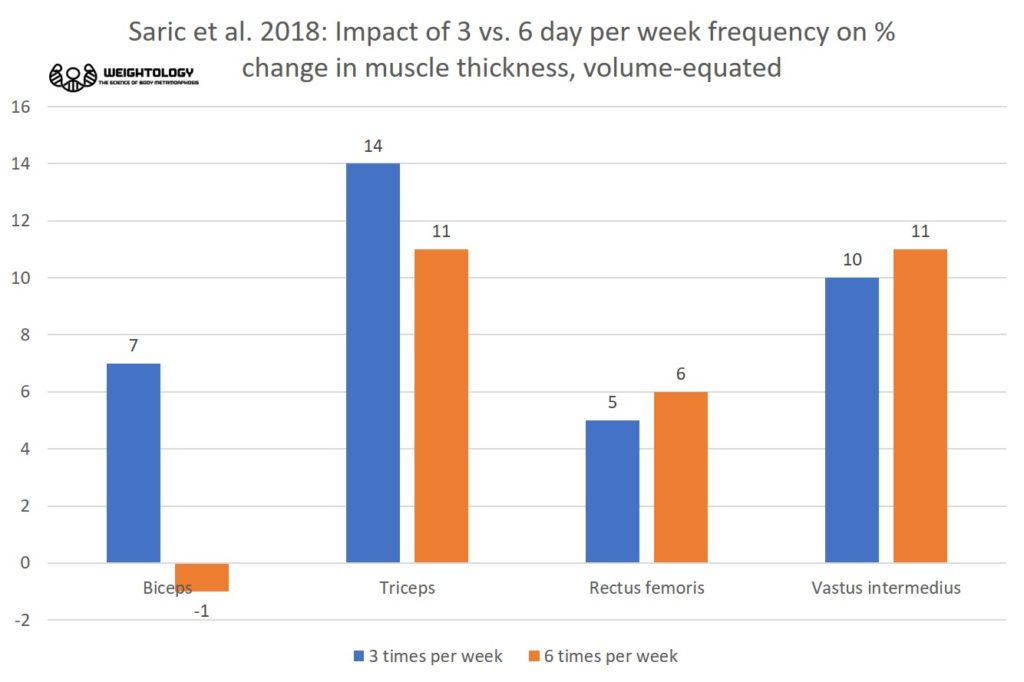
- In a study on which I was one of the authors, Saric and colleagues examined the effects of training each muscle group either 3 days per week or 6 days per week on a volume-equated basis in trained subjects. Total weekly volume was 12 sets per muscle group. There were no significant differences between the groups in triceps gains, rectus femoris gains, or vastus intermedius gains. Bicep thickness only significantly improved in the 3-day per week group.
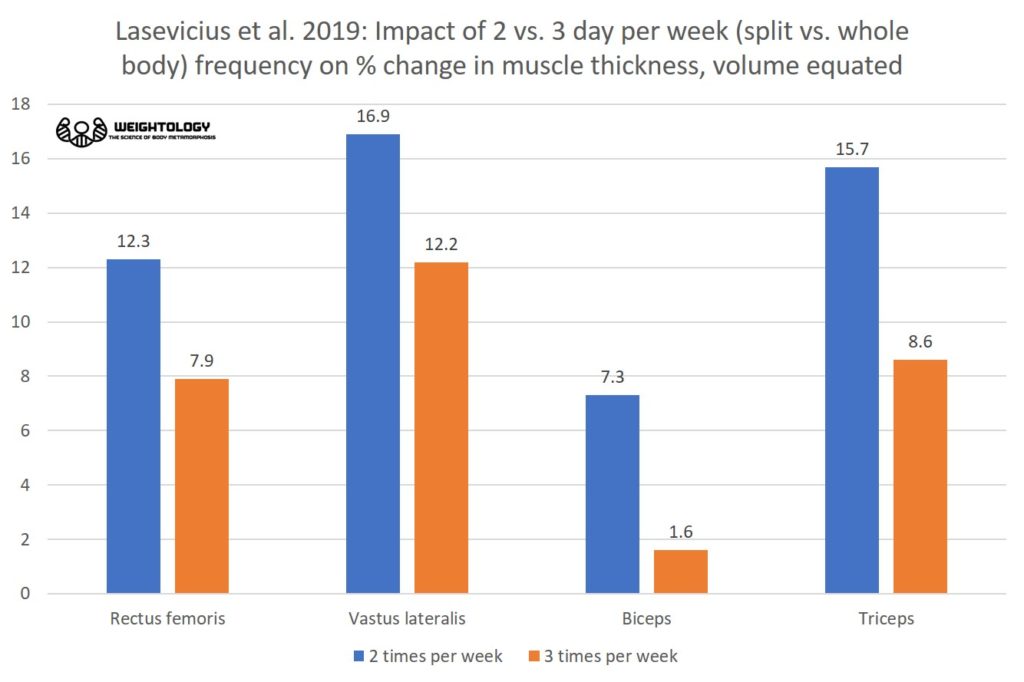
- Lasevicius and colleagues examined the effects of training each muscle group either 2 or 3 days per week in trained individuals. The group that trained each muscle twice per week performed an upper/lower split routine, while the group that trained each muscle three times per week performed a whole body routine. Total weekly volume was high (36 weekly sets for quads and and 24 weekly sets for arms). Thus, the whole body group was doing 12 sets for quads and 8 sets for arms three times per week, while the split group was doing 18 sets for quads and 12 sets for arms twice per week. There were no statistically significant differences in muscle gains between the groups, although percentage gains favored the 2 time per week split routine. While the percentage gains favored the split routine, it should be noted that the confidence intervals for the differences in muscle thickness were fairly wide, so it is very possible that the percentage differences are more due to random variance, but it is impossible to know without a bigger sample size (there were 14 subjects per group in this study). This study is at odds with the general idea that too much volume in a session might be counterproductive, since the split routine group had a higher per-session volume (12-18 sets vs. 8-12 sets). Of course, it's just one study, and I would say the weight of the evidence still favors not having too much volume in a single session. It should also be noted that the results of this study are the complete opposite of this study where a whole body routine 3 times per week tended to do better than a split routine 1-2 times per week.
The following table summarizes all of the published research to date:
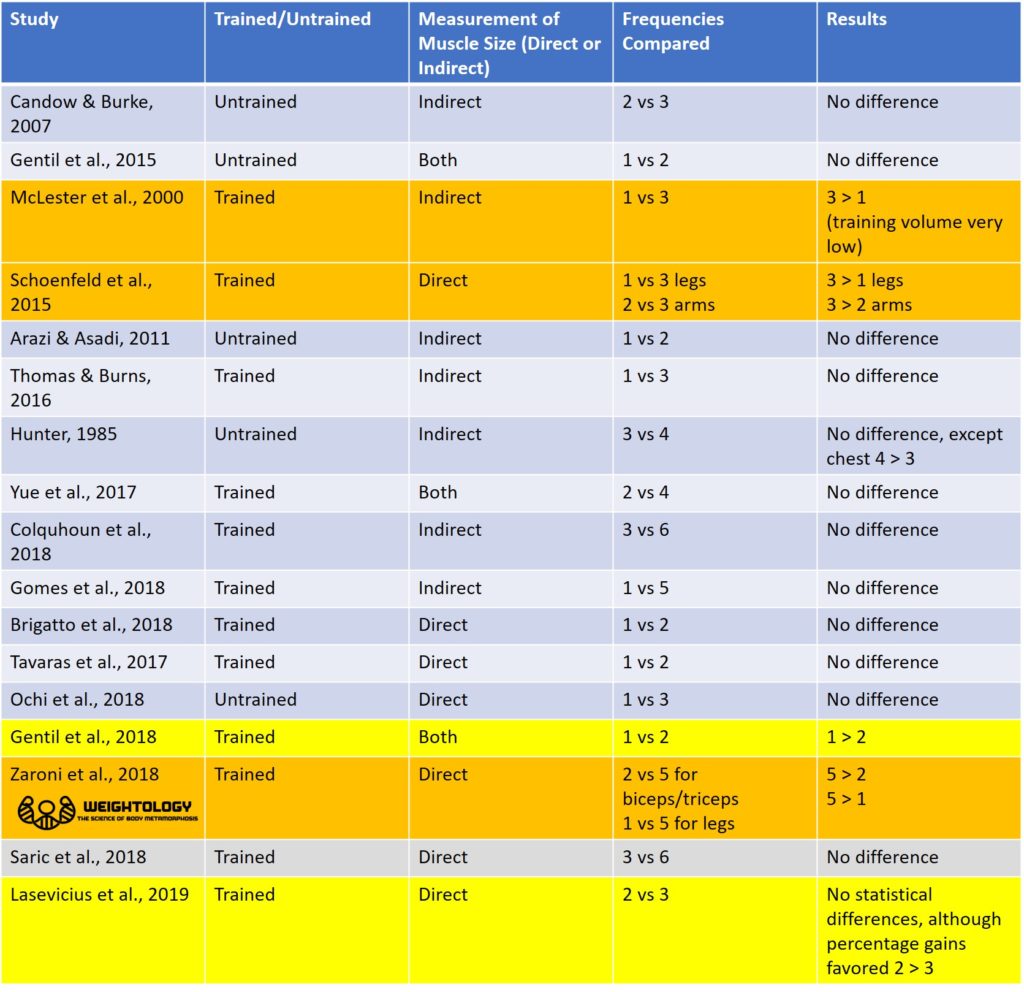
As you can see, most studies show no difference. Three studies (highlighted in orange) show a clear benefit of a higher frequency, and two (highlighted in yellow) shows a benefit of a low frequency. You can also see that there are distinct differences in the study designs, with some studies using trained subjects while others use untrained subjects, and some use direct measurements of muscle size (the most reliable and sensitive way to measure hypertrophy), while others use indirect measurements. Thus, comparing studies can be difficult, and it is challenging to assess where the weight of the evidence lies.
In situations like this, a meta-analysis can be useful. This is where you take a group of studies, and analyze them together as a whole to see if there are any trends. In 2016, I collaborated with Brad Schoenfeld and Dan Ogborn on a meta-analysis looking at the impacts of training frequency on hypertrophy. We showed that higher frequencies were associated with greater muscle gains than lower frequencies. However, a major confounder in this analysis is that some of the studies were not volume equated (i.e., the higher frequency group trained with more weekly volume). Unfortunately there were insufficient studies to examine the impact of frequency on a volume equated basis. There also weren't enough studies to tease out the effects of training a muscle group 1, 2, or 3 days per week, and we did not have any studies examining frequencies of 4 days per week or more.
An Updated Meta-Analysis
Since the publication of that meta-analysis, other research has since been published. In addition, two studies (here and here) were not included in that analysis which could have been included. Thus, I have performed an updated meta-analysis on all of the available volume-equated studies, including some of the unpublished research. While I am not of liberty to discuss the details of the unpublished work at this time, the results of those studies are incorporated into the final outcomes of this analysis. Therefore, this is the most up-to-date meta-analysis on training frequency that you will find anywhere.
First, I ran an analysis of all 17 studies. I divided frequency into "lower" or "higher" within each study. For example, if a study compared 1 time per week to 2 times per week, the 1 time per week was "Lower" and the 2 times per week was "Higher." If the study was 3 times per week versus 6 times per week, the 3 times per week was "Lower" and the 6 times per week was "Higher". I created an effect size for each outcome in the study, and also created an average effect size for the entire study. An effect size is a metric of the magnitude of an effect in terms of standard deviation units. For example, an effect size of 1, when comparing a lower frequency versus higher frequency, means the higher frequency group had greater gains by 1 standard deviation (which is a large effect). While there is debate over how to classify effect sizes (i.e., what might be a "large" effect in one scientific discipline may be small in another), traditionally, an effect size of less than 0.2 is considered trivial, 0.2 to 0.49 is small, 0.5 - 0.79 is moderate, and 0.80+ is considered large.
I analyzed the data using what is called robust variance random effects modeling for multilevel data structures, with adjustments for small samples. This probably sounds like a bunch of statistical gobbledygook to you, so I'll explain it in laymen's terms. Basically, when you have a study, you can often have multiple outcomes from the same study (like quadricep and bicep data). You have to account for the fact that those outcomes will be correlated, since they're from the same study (you can't treat them as independent). This is where the "multilevel data structures" comes in; my stats help account for this. Also, a "random effects" model, in laymen's terms, essentially means that I can't account for every possible source of variance between different studies, and that the "true" effect of frequency may vary somewhat randomly (rather than be a single value), so I need to incorporate that uncertainty into my stats. Finally, small samples can have some bias, so I need to adjust for it.
In addition to doing these stats, I ran a Bayesian meta analysis. While I won't go into what Bayesian statistics are, this type of meta-analysis allows you to get an idea of the range of values the frequency effect probably lies in, given the data. It is probability based. This is in contrast with the traditional method, which will give you a "significant" or "non-significant" result.
Now, each study is not weighted the same. Obviously, a study with a larger sample size (and hence more precision) should get more weight in the analysis. So, each study was weighted by the inverse of its variance (i.e., less variance = more precision = more weight).
I ran an analysis on all the studies. I also ran some analyses on the following subsets of data:
- Randomized controlled trials only. A few studies, like Hunter, are not randomized studies. This means that the subjects were not randomly assigned to their groups. In the case of Hunter, he simply compared people from different weight training classes at a University. The problem with non-randomized studies is that they can bias the analysis.
- Direct measurements of hypertrophy only. Studies using indirect measurements of hypertrophy (like DEXA or circumference measurements) are not as precise as studies that use direct measurements (like ultrasound).
- Upper body direct measurements only
- Lower body direct measurements only
- Trained subjects
- Low volume training (<10 weekly sets per muscle group)
- High volume training (10+ weekly sets per muscle group)
- Indirect measurements only
- Studies comparing 2+ times per week to 1 time per week (direct measurements only)
- Studies comparing 3+ times per week to 1-2 times per week (direct measurements only)
- Studies comparing 4+ times per week to 1-3 times per week (direct measurements only)
Meta-Analysis Results
Here's the table showing the meta-analysis results. The first column shows the analysis. The second column shows the number of studies in that analysis. The third column shows the effect size. The fourth column shows the 95% confidence interval for that effect size. The fifth column shows the P value (anything less than 0.05 is generally considered "significant"). The sixth column shows the effect size for the Bayesian analysis. The seventh column shows the "Bayesian Credible Interval", which gives you the range of values that the effect size probably lies in, given the data. The final column shows the percentage point difference for lower versus higher frequency; for example, a 0.7% percentage difference would mean that if the lower frequency showed a gain of 5%, the higher frequency showed a gain of 5.7%.
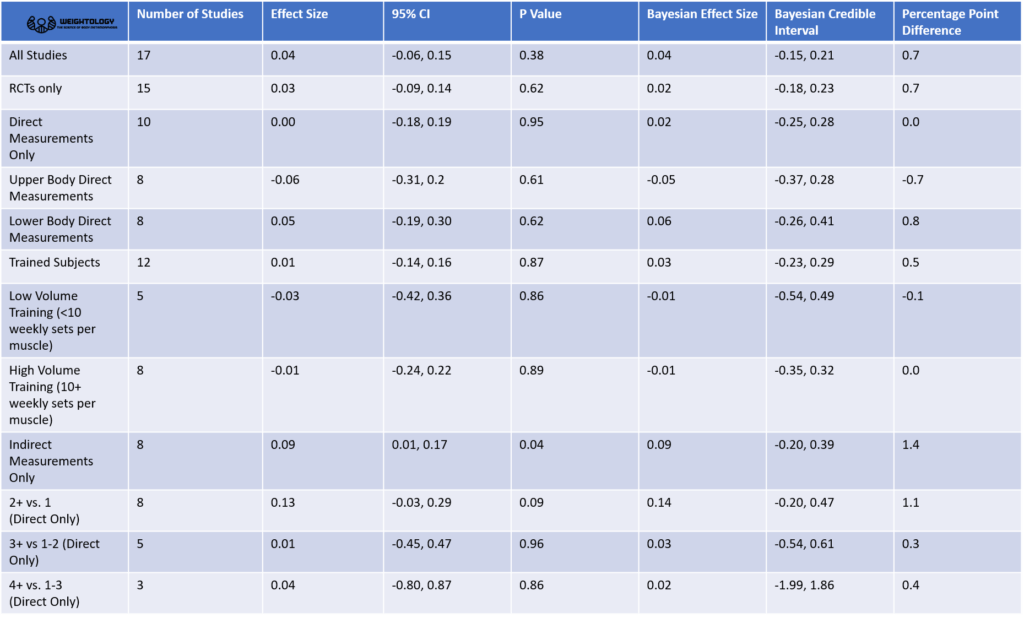
You can see that in the analysis of all studies, there was no significant effect of frequency on hypertrophy on a volume equated basis. The effect size was only 0.04, which is practically zero. In the Bayesian analysis, we get a similar effect size of 0.04, and a 95% credible interval of (-0.15, 0.21), meaning that, in all probability, the effect is trivial.
Here's what's called a posterior distribution plot for the Bayesian meta analysis. You can see that most of the effect sizes are distributed between -0.2 and 0.2, meaning that it is highly unlikely that higher frequencies give you anything more than a trivial effect on a volume equated basis.
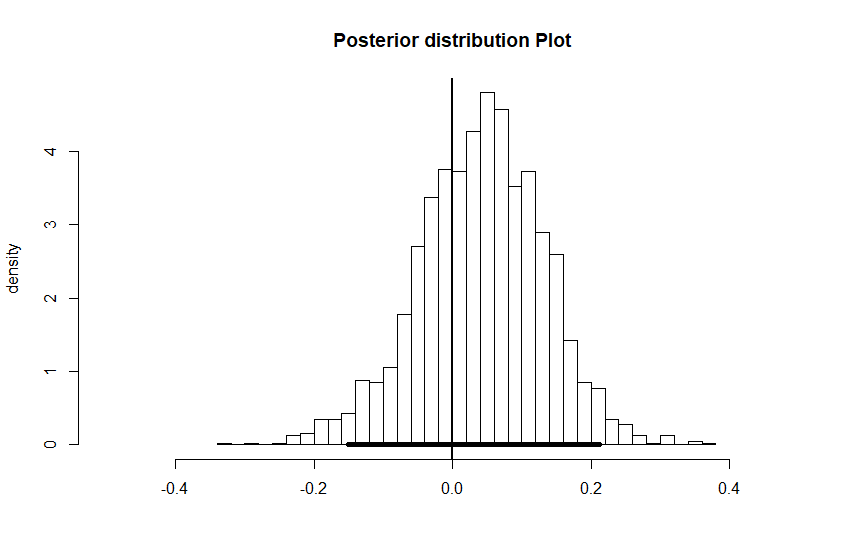
Posterior distribution plot for the effect of training frequency on hypertrophy on a volume equated basis. You can see that the density of bars is highest between the credible interval of -0.15 and 0.21 represented by the dark black bar. In other words, most of the bars fall in the trivial range. This means that frequency likely has a trivial impact on hypertrophy when you equate for weekly volume
Also, as you can see in the above table, in almost all of the sub-analyses, frequency has practically no effect on hypertrophy on a volume equated basis. Almost none of the results are statistically significant, and the effect sizes are in the "trivial" range (<0.2).
Only two sub-analyses came close to statistical significance. In the isolated analysis on "bro-split" training, the P value was 0.09 with a trivial effect size of 0.13. The Bayesian results were similar. If we look at the posterior distribution plot, most of the effect sizes are distributed in the trivial to small range. This indicates that going from a bro-split to training each muscle group 2+ times per week will probably give you only a trivial to small advantage in gains on a volume equated basis. However, there is a caveat to this which I will discuss later.
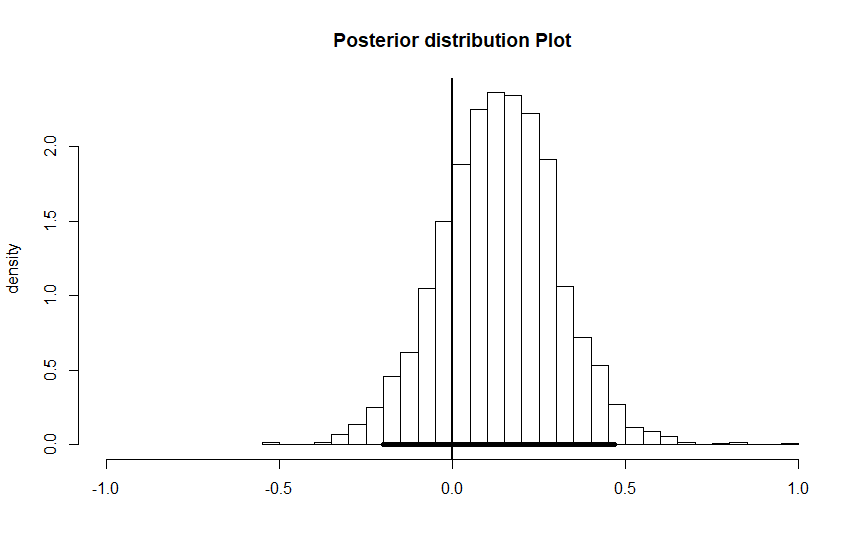
Posterior distribution plot for studies comparing a frequency of 1 time per week to 2+ times per week on a volume equated basis. The 95% credible interval (represented by the dark black horizontal line) is -0.20, 0.47. Most of the bars are distributed in the trivial (<0.2) to small (0.2 to 0.49) range, suggesting that a frequency of 2+ times per week has, at best, a trivial to small effect on gains on a volume equated basis
The only analysis that ended up being statistically significant was the one on indirect measurements of hypertrophy. However, the effect was trivial (0.09). Here's the Forest plot of this analysis; the dashed line represents the average effect size, and the size of each square represents the weight of the study in the analysis.
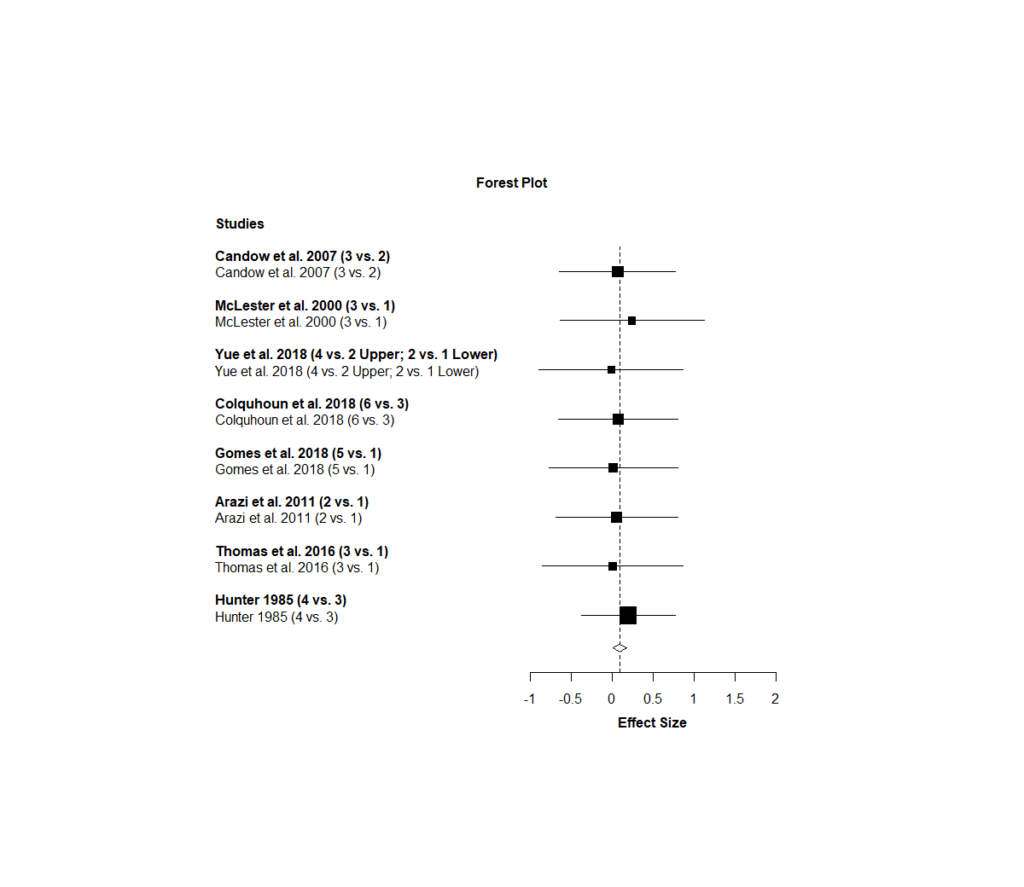
The study by Hunter got a large weight in the analysis due to the larger sample size, but it should be noted that this study was a non-randomized study (which may bias the analysis) and used circumference measurements and skinfolds to assess body composition (which can be problematic when trying to infer changes in lean mass). Likewise, the study by McLester, while not getting as much weight, showed the largest effect, but they used skinfolds to assess body composition. Thus, I would doubt the reliability of the outcome for indirect measurements.
Meta-Regression Results
To get an idea of the of how gains compare between 1, 2, 3, or 4-6 days per week, I performed a meta-regression of all 17 studies. Here are the results of that analysis. Controlling for the number of weeks, the measurement type, and the study design, there was no significant effect of training frequency whether I treat it as a continuous variable (P = 0.21) or as a categorical variable (P = 0.27), and no meaningful pattern in the effect sizes or percentage gains between the different frequencies.
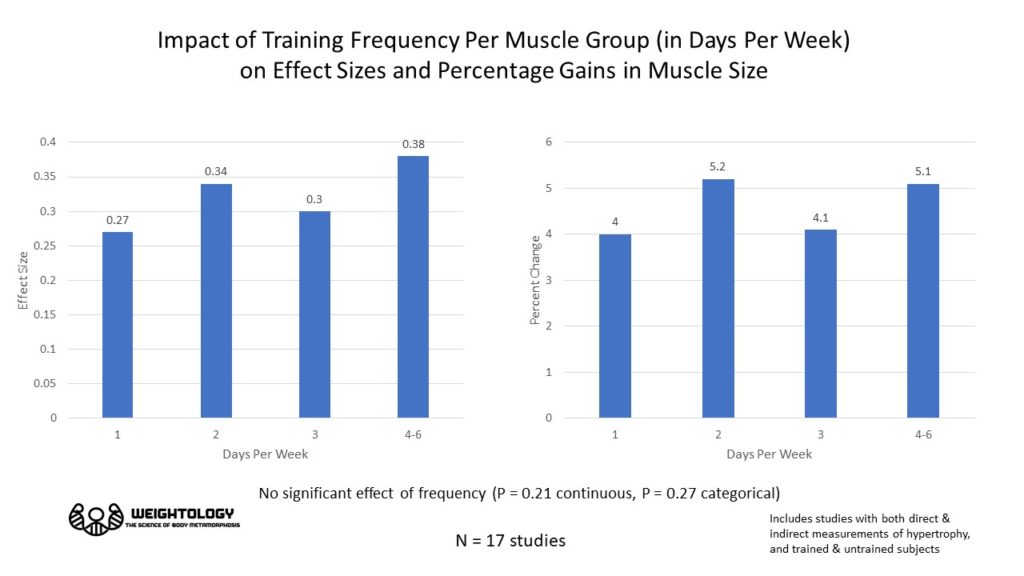
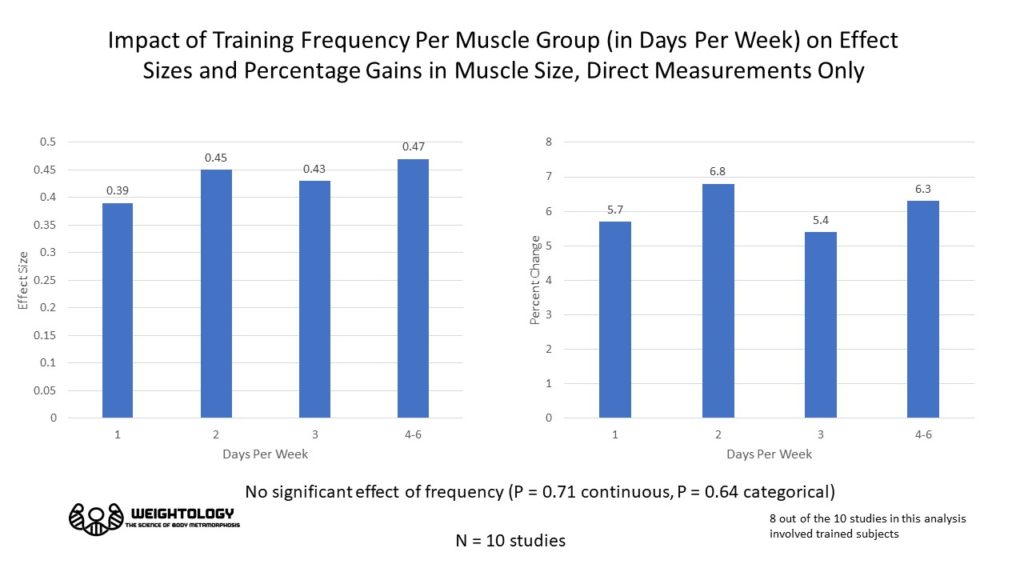
The above analysis includes studies that use indirect measurements of muscle size, which are not as sensitive for detecting differences between groups. When I isolate the analysis to only studies involving direct measurements of muscle size, there again is no significant effect of frequency. In fact, the P value becomes even more insignificant (P = 0.71 if I treat frequency as a continuous variable, and P = 0.64 if I treat it as a categorical variable). The effect sizes and percentage changes for the different frequencies are fairly similar, with no discernible pattern. It should be noted that 8 out of the 10 studies in this analysis involved trained subjects.
The Volume-Frequency Interaction
While this data suggests the "bro-split" of training each muscle group once per week isn't much worse than more frequent training, this is likely dependent upon training volume. In the Volume Bible, the data suggested an upper limit of training volume for each individual session. While that may appear to contradict the meta-analyses in this article, the vast majority of studies in this article do not exceed 10 sets per session. Only three studies involved a frequency where the per-session volume greatly exceeded 10 sets. Zaroni and colleagues compared 15 sets per session, done once or twice per week, to 3-6 sets per session, done five times per week. Hypertrophy was superior in the higher frequency condition. Brigatto and colleagues compared 16 sets per session, done once per week, to 8 sets per session done twice per week. Hypertrophy was similar between the conditions. However, improvements in training load volume were superior in the higher frequency group. Finally, Lasevicius and colleagues examined the effects of training each muscle group either 2 or 3 days per week in trained individuals; per-session volume ranged from 12-18 sets in the 2-day per week group, and 8-12 sets in the 3-day per week group. This was one study where the evidence tilted against the idea of a max per-session volume threshold and towards a benefit for the very high session volumes, as percentage gains favored the lower frequency group. However, this is just one study, and the weight of the evidence, when considering these three studies and data from the Volume Bible, suggests that very high per-session volumes are not ideal. Thus, training frequency likely doesn't make a difference when the per-session volume is less than around 10 sets and you're taking reasonable rest intervals (2+ minutes). However, if it greatly exceeds 10 sets, then it may be more beneficial to split the volume into a higher frequency.
Key Conclusions from the Meta-Analyses
The takeaway points from these meta-analyses are as follows:
- There is no distinct advantage to high frequency training. Gains were similar with high frequencies compared to lower frequencies, whether looking at all studies or just direct measurements. Also, when looking at the 10 studies involving direct measurements, four studies favored higher frequency, three favored lower frequency, and three showed no difference. If there truly was an advantage to higher frequencies, results would more consistently favor higher frequencies among studies.
- The differences between various frequencies are relatively small. This means that you can choose a training frequency that fits your schedule and preferences, and it won't make much of a difference in your gains.
- Volume > frequency. In the volume bible, there was a clear impact of training volume on muscle hypertrophy. In this analysis, frequency appears to have minor impacts on hypertrophy at best. This means it's more important to focus on manipulating volume rather than frequency when you're trying to get bigger. Rather, frequency can be used as a tool to increase volume and perform more quality sets. Rather than continuing to add more and more volume in a single session, where accumulated fatigue could limit your performance and adaptations, you add another training day or two for a particular muscle group during the week.
- Even though volume > frequency, the importance of frequency increases as volume increases to high levels. In the volume bible, I outlined evidence that there may be a limit to how many effective sets you can do in a single training session, and anything beyond that can be considered "junk volume". This appears to be around 6-8 sets per muscle group on average when taking long rests between sets. Thus, if you're training with 15+ sets per muscle group per session and taking long rests, it may be more effective to split the volume up into more frequent sessions.
- The bro-split isn't as bad as some believe if training volume is low to moderate, but is likely an inferior way to train if training volume is high. In these analyses, the bro-split of training one muscle group per week was not statistically different from any other frequency, and the Bayesian analysis only suggested that trivial to small benefit to a higher frequency. However, there is a caveat to this. As demonstrated in the Volume Bible, there is an interaction between volume and frequency, and there is likely an upper limit to "effective" volume in a single training session. The high volume bro-splits, where you train each muscle group for 15-20+ sets in a single training session, may not be a great way to train.
One important caveat to these analyses is that they only apply to situations where you're doing most sets to failure or near failure, and where you're training in moderate to high repetition ranges. If a lot of your training is submaximal and well short of failure, and/or you're training a lot in powerlifting ranges (<6 reps), then appropriate training frequencies may be different.
Differences from Greg Nuckols's Analysis
Some of you who have read Greg Nuckols's meta-analysis on frequency will note that my conclusions are different from his. There are some possible reasons for this (some of which Greg also outlined in his article):
- I have two sutdies in my analysis that weren't in Greg's analysis at the time of writing this. In both of these studies, the effect sizes tended to favor the lower frequency groups, which would bring the overall impact of frequency towards zero.
- Greg rightly noted that my meta-regression is not as sensitive to changes in frequency since it is simultaneously modeling the effects within each study as well as the effects between studies. The modeling of the effects between studies, by averaging the results of one particular frequency across different studies, may mask potentially small benefits of higher frequencies. However, in this updated addendum, I've now performed meta-analyses (not regression) and sub-analyses similar to Greg's where I examined only the effects within each study (i.e., when comparing 1 to 2+, I only included studies that directly compared 1 to 2+, rather than lumping in studies that may have compared 2 to 3 or 3 to 6 in the 2+ category). Even in these sub-analyses, I largely failed to find anything beyond a trivial effect of frequency.
- There are some differences in the statistical models we use, although I doubt that would be responsible for some of the larger differences we see in our results (for example, Greg gets highly significant effects of frequency and I do not).
- I performed a small-sample size correction on my effect sizes, because calculated effect sizes for small samples tend to be exaggerated. However, this would account for only a very small difference in our results.
All that said, while there are some large differences in our outcomes, there are some differences between my analysis and Greg's that aren't very big. For example, he found a trivial effect size when looking across all studies (0.11), although it was statistically significant. My overall effect was also trivial (0.04), and was not statistically significant.
Other Frequency Studies
No bible on training frequency would be complete without a discussion of three studies in this area. Let's talk about these studies and see if there's anything we can take away from them.
The Norwegian Frequency Project
One study that has often been mentioned in support of higher training frequencies is the Norwegian Frequency Project. In this study (which has never been peer reviewed; it's only been presented as an abstract at conferences), elite competitive Norwegian powerlifters were divided into two groups. All of them were put on the same 15 week training program, with the same exercises, weekly volume, and intensity. However, one group trained 3 days per week, and the other trained 6 days per week. The group that split their volume up into 6 weekly sessions showed more muscle gains on average than the group that did three weekly sessions. Here's some scatter plots of the changes in muscle thickness of the vastus lateralis (a muscle in the quadriceps), and of changes in the cross-sectional area of the quadriceps. While the differences do not reach the threshold of statistical significance, there is a clear advantage to the higher frequency group.
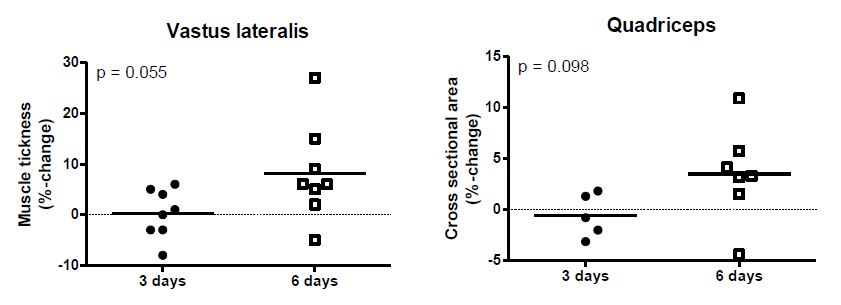
While the results are intriguing, there are significant limitations to this study that preclude it being strong evidence for the use of higher training frequencies for bodybuilding:
- These were powerlifters, not bodybuilders. Powerlifters typically train with much lower training volumes than bodybuilders. Thus, the results may not apply towards typical hypertrophy-oriented training routines that have greater volumes and repetitions per set.
- Most of the training was submaximal. Reps were often between 3 and 8 for the three powerlifts, but with weights that would amount to a 10-15 RM load. Thus, a lot of training was well short of failure.
- These were elite competitive lifters with superior genetics. Results may not apply to the average person.
At best, this study hints that higher frequencies may be better if your training volumes are more typical of a powerlifter, and if most of your training is submaximal (this makes sense as I had mentioned earlier that recovery is dramatically improved if you train well short of failure). But it isn't necessarily supportive of higher training frequencies for hypertrophy-oriented routines.
The Hakkinen Two-A-Day Study
Another study that has often been cited in support of higher training frequencies is a 1994 study on female athletes. However, this study is not a true higher frequency study. In this study, the women spent 3 weeks on their normal training regimens, and then 3 weeks on a training regimen where their daily sessions were split into two daily sessions. The training program was focused on the quadriceps, and was performed every other day. Training consisted of squats, and either leg press or leg extensions. When the women performed two daily sessions, they did squats in the first session and the other leg exercise in the second session. When the women trained twice per day, they experienced a small 4% increase in quadriceps cross-sectional area. However, training frequency on a daily basis was the same between the two conditions; it's just that in one condition, sessions were split into two sessions. This is likely more similar to increasing rest intervals (where long rest intervals have been shown to be beneficial for hypertrophy), rather than increasing training frequency. Also, it should be noted that the researchers in this study did not use the appropriate statistical procedures for the data.
The Daily 1-RM/10-RM Study
A third study that involved high training frequencies was a study I reviewed here at Weightology. In this study, subjects did 3 sets of 10 RM of biceps curls on a daily basis for 3 weeks. They experienced a significant increase in biceps size in that time period. However, all of the increase occurred in the first week of training, which is 7 sessions. There was no further increase for the next 2 weeks, despite daily training and an accumulation of 14 additional training sessions. This would question the benefit of higher training frequencies done for any longer than extremely short time periods.
Coming to Consilience
In science, there is something called a "convergence of evidence", also known as "consilience." This is where, when multiple sources of evidence are in agreement, the conclusion can be strong even if the conclusion from any one particular piece of evidence is not strong. Here's where the various lines of evidence regarding training frequency are pointing:
- Myofibrillar protein synthesis recovery: Once every 2-4 days or 2-3 days per week
- Muscle damage recovery: Once every 4-5 days or 1.5 to 2 days per week when unaccustomed to the protocol, but likely more frequent when accustomed
- Strength recovery: Once every 3-5 days or 1.5 to 2 days per week, but likely more frequent when accustomed
- Total work recovery: Once every 2-3 days for low session volumes, and once every 4-5 days for moderate to high session volumes, or 1.5 to 2 days per week, but likely more frequent when accustomed
- Meta-analyses on training frequency: Statistically no difference between various training frequencies, although there is evidence that 2+ may be slightly better than 1, and may be significantly better when training volume is high
Overall, the recovery data likely favors a frequency of 2-4 days per week once you are accustomed to a training protocol. However, looking at the meta-analytic data, frequency likely plays a very minor role in hypertrophy, and it is likely best to choose a frequency that works best for you and your recovery abilities, and which allows you to train with sufficient quality volume.
There are a number of points to consider regarding this conclusion:
- These conclusions are based on average responses. Individual needs for frequency may vary widely, and will depend upon factors such as individual recovery ability and tolerance, session volume, nutritional status, joint integrity/injury history, etc.
- These conclusions assume you train to failure or near failure for most of your sets. If a lot of your training is submaximal and is well short of failure, training frequency may need to be higher (although impacts on things like joints still need to be considered even when training short of failure).
- This assumes you are training in moderate to high rep ranges, and your primary goal is hypertrophy. If you train regularly in powerlifting rep ranges (<6) and are training for strength, then appropriate frequency may be different.
- These conclusions mainly apply to young subjects, as most of the research has been done on this age group. Research indicates that recovery ability is impaired in older individuals (particularly 50+), and ideal frequencies may be slightly lower in this population.
Overall, there is no significant or meaningful difference between various training frequencies (with a few exceptions, like high volume bro-splits). This means you can use a training frequency that fits your preferences and schedule, without significantly hampering your gains. It is likely best to use frequency as a tool to manipulate weekly volume, allowing you to perform more high quality hard sets. For example, let's say your arms get trained once per week for 10 sets. If you want to increase your weekly arm volume from 10 sets to 20, it would make more sense to add a few training sessions of 5 sets each during the week, rather than add another 10 sets onto the same session.
Hey James, it’s me again … sorry for the many questions I’m asking….
If we ignore all other recovery factors and consider only MPS. Can we say that ,ore frequent stimulation of MPS is beneficial up to a point. Do you think we can train and produce an elevation in MPS while there is still one happening from the last workout? How likely it is to have a smaller effect if we try and elevate MPS when it is still elevated?
Yes, I do think you can stimulate MPS even if it’s elevated from a previous workout. This would be no different from taking a particular set volume (say, 6 sets), and doing 3 sets one day and 3 sets the next. The cumulative MPS response over the 2 days will be the same as if you did all 6 sets in one day.
Hi James! Love your work and thanks a lot.
One clarification question. From your volume bible, if I got it right, the max number of effective sets per session may be towards the upper end (likely towards 13) if we use compound movements. From frequency bible, I’m left w/ the impression that fatiguing big movements require lower per session volume (probably 8 sets). What are your thoughts on that now? I know articles have been written at different time span and ideas and conclusions always change/develop.
We really don’t know whether the max number of effective sets is different between isolation and compound movements. That said, the upper end is more on the peak of the curve of 8-10 sets, which is consistent with fatiguing big movements requiring lower session volume of 8 sets as you mentioned.
James (sorry to pester so much lately, my mind has been on full throttle), since it appears that frequency is a non-issue (within reason) are we them left with one of two likely conclusions: 1. The MPS cycle is not the best proxy for assessing optimal frequency for hypertrophy Or 2. Doing more sets per session results in a larger MPS curve that ends up matching (as to total area under curve) the smaller MPS “hits” from lower volume / higher frequency schemes As in perhaps 10 sets stimulates a theoretical 100 growth units (made up, obviously) and 3 sets… Read more »
Hi, Chris,
First, we still don’t know a whole lot about the length of the MPS cycle, and also how it might vary with factors like training volume. So, for now, yes, it’s not the best proxy.
#2 appears true to a point until the volume in a single session gets beyond a threshold. Once it gets too high in a single session, there may be too much muscle damage or the response may be impaired.
Do I understand correctly that whole the data do seem to point to 4-5 days between body parts, the crux of that conclusion comes from the limited time duration of study? What makes you so strongly suspect that being trained makes the much of a difference, James?
Just trying to wrap my head around whether there is enough evidence to justify shortening the optimal rest between like sessions.
Thanks
Hi, Chris, the problem with that conclusion is that the data is derived from people who are not accustomed to the protocol. When you embark on a new protocol, or you train with a low frequency, you will get significant muscle damage (even if you’re experienced). This delays recovery. However, with repeated bouts, muscle damage is reduced, if not eliminated (this is why you don’t get sore with more frequent training). This is why the 4-5 day window is probably not accurate if you’ve become accustomed to the protocol.
Thank you James. So despite having years of experience (basically the same as yourself), it likely may not be the most prudent choice to go with a upper / lower split over 3 days per week?
Mon: A
Wed: B
Fri: A
Mon: B
Wed: A
Fri: B
Once I’ve ran this for a while, you feel I may be not optimizing my results by taking these 4-5 days between similar sessions?
I do think you might get slightly better results with a bit more frequency (i.e., 4-day per week upper/lower split) so that you get more repeated bout effect
For clarity, I’m referring to this one…
https://www.tandfonline.com/doi/abs/10.1080/02640414.2018.1555906?journalCode=rjsp20&fbclid=IwAR13tXgpj8lF2ZfrdrSxnqPdzrmokzBbw59AhzDKY9kZepJeh21dqiNP9wA
James, how does the new Meta from Brad that came out in November affect your conclusions, if at all?
The one where they determine frequency doesn’t seem to matter at all with equated volume.
It doesn’t really affect it (note that I was one of the authors that paper…I ran the stats). In fact, our conclusions are fairly similar. I included more studies in this analysis, and also dove a bit deeper into a few of the low frequency/high volume studies.
Overall, frequency likely doesn’t matter much, unless it’s very low (i.e., bro-split) and per-session volume gets very high (>10 sets), then it might be better to split the volume up into more frequent sessions.
James for an advanced bodybuilder is there any such thing as too few assets per session to reach a growth threshold? Specifically I’m thinking of using five sets per body part three times per week contrasted with 8 to 10 sets per body part twice per week. Using the 8 to 10 from your volume update with these numbers being where hypertrophy seems to be capped per session. Thank you, Chris Blair
“assets” = of sets. Text to speech…Lol
Hi, Chris,
I would say theoretically, yes, but it’s hard to say what that minimum threshold is for advanced trainees. I think you’ll be perfectly fine with 5 sets 3x per week compared to 8-10 twice per week.
Sorry, one more Q: How resistance to damage differs between beginner vs advanced lifter? Do muscles become more resistant to damage or training experience improves recovery capacity too, or both? If muscles become more resistant to damage, perhaps we need to increase volume but not frequency. But if recovery capacity improves, advanced lifter would benefit from higher frequency.
Hi, Boz,
Advanced lifters are more resistant to muscle damage. There is also evidence that recovery capacity can improve as you become more advanced. So advanced lifters might benefit from both an increase in volume and frequency. However, this is highly individual and dependent upon a number of factors that are outlined both in this article and in the Volume Bible.
Hi James! Great analysis and appreciate new updates. Have couple of questions: (1) You say 1-2 RTF would not make a difference for muscle damage compared to training to failure, because damage is mostly result of mechanical loading, rather than fatigue. Have you come across data that shows relationship between fatigue and muscle damage? I read somewhere that calcium and inflammatory agents build up may degrade the inside of the muscle cell, causing damage. (2) How do you define low, medium, and high volume sessions in terms of number of sets to (near)failure? (3) I remember, there was a study… Read more »
Hi, Boz. 1. There’s some evidence that fatigue can contribute to muscle damage, although the data is not consistent. That said, 1-2 RIR isn’t enough to cause significantly less damage than going to failure. You would need something like 5 RIR to perhaps see a difference, but then that’s where you are getting less high threshold motor unit recruitment. 2. Check out the Volume Bible for definitions of low, medium, and high volumes in a session. 3. The frequency study you refer to was done on beginners and only lasted 8 weeks. Thus, it’s hard to make inferences from this… Read more »
James, building on your last point in the update, what seems to be the best per session volume? In the context of your 10 sets moving to 20 sets by dividing the increase over more sessions.
Are maybe @ 10 sets close to max “per session” response?
I think the best “per session” volume is highly individual. It may also depend upon the types of exercises being performed. For example, if you’re doing highly fatiguing compound movements like squats, your per session volume might be better towards the lower end, compared to if you’re doing a bunch of single joint movements which aren’t as systemically taxing.