
Insulin: A Primer
Insulin is a hormone that regulates the levels of sugar in your blood. When you eat a meal, the carbohydrate in the meal is broken down into glucose (a sugar used as energy by your cells). The glucose enters your blood. Your pancreas senses the rising glucose and releases insulin. Insulin allows the glucose to enter your liver, muscle, and fat cells. Once your blood glucose starts to come back down, insulin levels come back down too. This cycle happens throughout the day. You eat a meal, glucose goes up, insulin goes up, glucose goes down, and insulin goes down. Insulin levels are typically lowest in the early morning since it's usually been at least 8 hours after your last meal.
Insulin doesn't just regulate blood sugar. It has other effects as well. For example, it stimulates your muscles to build new protein (a process called protein synthesis). It also inhibits lipolysis (the breakdown of fat) and stimulates lipogenesis (the creation of fat).
It is the latter effect by which insulin has gotten its bad reputation. Because carbohydrate stimulates your body to release insulin, it has caused some people to argue that a diet high in carbohydrate will cause you to gain fat. Their reasoning, in a nutshell, goes like this:
High Carbohydrate Diet -> High Insulin -> Increased Lipogenesis/Decreased Lipolysis -> Increased Body Fat -> Obesity
Using this same logic, they argue that a low carbohydrate diet is best for fat loss, because insulin levels are kept low. Their logic chain goes something like this:
Low Carbohydrate Diet -> Low Insulin -> Decreased Lipogenesis/Increased Lipolysis -> Decreased Body Fat
However, this logic is based on many myths. Let's look at many of the myths surrounding insulin.
MYTH:A High Carbohydrate Diet Leads to Chronically High Insulin Levels
FACT:Insulin Is Only Elevated During the Time After a Meal In Healthy Individuals
One misconception regarding a high carbohydrate intake is that it will lead to chronically high insulin levels, meaning you will gain fat because lipogenesis will constantly exceed lipolysis (remember that fat gain can only occur if the rate of lipogenesis exceeds the rate of lipolysis). However, in healthy people, insulin only goes up in response to meals. This means that lipogenesis will only exceed lipolysis during the hours after a meal (known as the postprandial period). During times when you are fasting (such as extended times between meals, or when you are asleep), lipolysis will exceed lipogenesis (meaning you are burning fat). Over a 24-hour period, it will all balance out (assuming your are not consuming more calories than you are expending), meaning you do not gain weight. Here's a graph showing how this works:
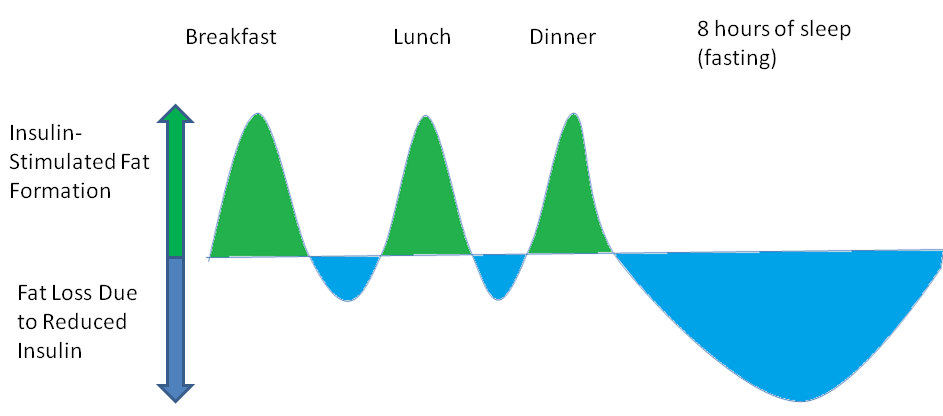
After meals, fat is deposited with the help of insulin. However, between meals and during sleep, fat is lost. Fat balance will be zero over a 24-hour period if energy intake matches energy expenditure.
This is just a rough chart that I made, but the green area represents the lipogenesis occuring in response to a meal. The blue area represents lipolysis occuring in response to fasting between meals and during sleep. Over a 24-hour period, these will be balanced assuming you are not consuming more calories than you expend. This is true even if carbohydrate intake is high. In fact, there are populations that consume high carbohydrate diets and do not have high obesity rates, such as the traditional diet of the Okinawans. Also, if energy intake is lower than energy expenditure, a high carbohydrate diet will result in weight loss just as any other diet.
MYTH: Carbohydrate Drives Insulin, Which Drives Fat Storage
FACT: Your Body Can Synthesize and Store Fat Even When Insulin Is Low
One of the biggest misconceptions regarding insulin is that it's needed for fat storage. It isn't. Your body has ways to store and retain fat even when insulin is low. For example, there is an enzyme in your fat cells called hormone-sensitive lipase (HSL). HSL helps break down fat. Insulin suppresses the activity of HSL, and thus suppresses the breakdown of fat. This has caused people to point fingers at carbohydrate for causing fat gain.
However, fat will also suppress HSL even when insulin levels are low. This means you will be unable to lose fat even when carbohydrate intake is low, if you are overeating on calories. If you ate no carbohydrate but 5,000 calories of fat, you would still be unable to lose fat even though insulin would not be elevated. This would be because the high fat intake would suppress HSL. This also means that, if you're on a low carbohydrate diet, you still need to eat less calories than you expend to lose weight.
Now, some people might say, "Just try and consume 5000 calories of olive oil and see how far you get." Well, 5000 calories of olive oil isn't very palatable so of course I won't get very far. I wouldn't get very far consuming 5,000 calories of pure table sugar either.
MYTH: Insulin Makes You Hungry
FACT: Insulin Suppresses Appetite
It is a well known fact that insulin acutely suppresses appetite. This has been demonstrated in dozens and dozens of experiments. This will be important when we talk about the next misconception...
MYTH: Carbohydrate Is Singularly Responsible for Driving Insulin
FACT: Protein Is a Potent Stimulator of Insulin Too
This is probably the biggest misconception that is out there. Carbohydrates get a bad rap because of their effect on insulin, but protein stimulates insulin secretion as well. In fact, it can be just as potent of a stimulus for insulin as carbohydrate. One recent study compared the effects of two different meals on insulin. One meal contained 21 grams of protein and 125 grams of carbohydrate. The other meal contained 75 grams of protein and 75 grams of carbohydrate. Both meals contained 675 calories. Here is a chart of the insulin response:
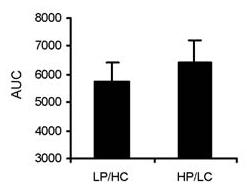
Comparison of insulin response between low protein, high carb meal and high protein, low carb meal
Now here's a chart of the blood sugar response:
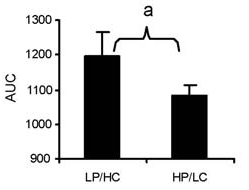
Comparison of blood sugar response to low protein, high carb meal and high protein, low carb meal
You can see that, despite the fact that the blood sugar response was much higher in the meal with more carbohydrate, the insulin response wasn't higher. In fact, the insulin response was somewhat higher after the high protein meal, although this wasn't statistically significant.
Some people might argue that the "low-carb" condition wasn't really low carb because it had 75 grams of carbohydrate. But that's not the point. The point is that the high-carb condition had nearly TWICE as much carbohydrate, along with a HIGHER glucose response, yet insulin secretion was slightly LOWER. The protein was just as powerful at stimulating insulin as the carbohydrate.
I can also hear arguments coming like, "Yeah, but the insulin response is longer and more drawn out with protein." That wasn't true in this study either.
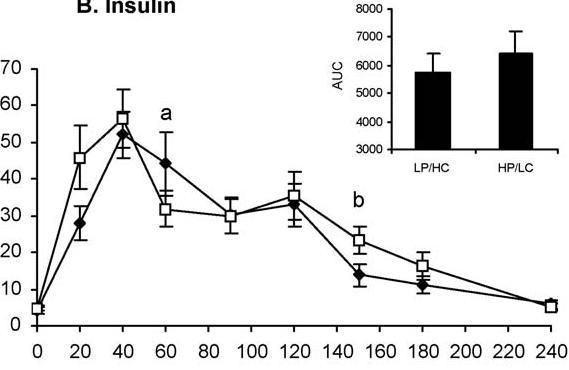
Insulin response to high protein and high carb meals
You can see in the chart that there was a trend for insulin to peak faster with the high protein condition, with a mean response of 45 uU/mL at 20 minutes after the meal, versus around 30 uU/mL in the high carb condition.
This tendency for a higher insulin response was associated with a tendency towards more appetite suppression. The subjects had a tendency towards less hunger and more fullness after the high protein meal:
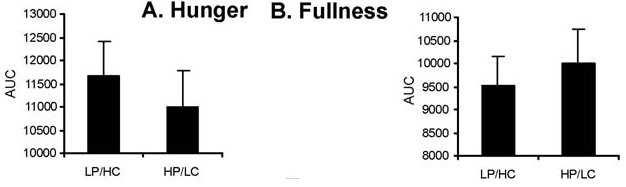
Comparison of low protein, high carb and high protein, low carb meals and their effects on hunger and fullness
Here's the results of another study that compared the effects of 4 different types of protein on the insulin response to a meal. This study was interesting because they made milkshakes out of the different proteins (tuna shakes???? YUCK!!!!! Of course some people may remember the tuna shake recipes from the misc.fitness.weights days). The shakes contained only 11 grams of carbohydrate, and 51 grams of protein. Here's the insulin response to the different shakes:
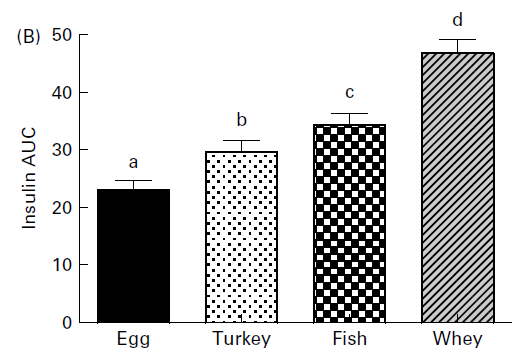
Insulin Response to 4 Different Proteins
You can see that all of these proteins produced an insulin response, despite the fact that the carbohydrate in the shake was low. There was also different insulin responses between the proteins, with whey producing the highest insulin response.
Now, some might argue that the response is due to gluconeogenesis (a process by which your liver converts protein to glucose). The thought is that the protein will be converted to glucose, which will then raise insulin levels. As I mentioned earlier, people will claim that this will result in a much slower, more drawn-out insulin response, since it takes time for your liver to turn protein into glucose. However, that's not the case, because the insulin response was rapid, peaking within 30 minutes and coming back down quickly at 60 minutes:
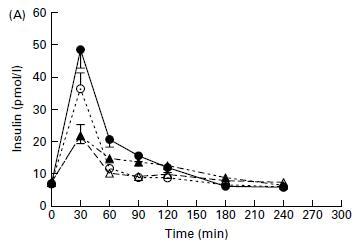
Insulin response to different types of protein
This rapid insulin response was not due to changes in blood glucose. In fact, whey protein, which caused the greatest insulin response, caused a drop in blood glucose:
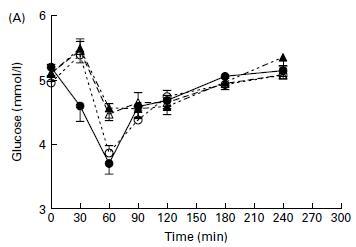
Glucose response to different types of protein
The insulin response was associated with appetite suppression. In fact, the whey protein, which had the highest insulin response, caused the greatest suppression of appetite. Here's a chart showing the calorie intake of the subjects when they ate lunch 4 hours after drinking the shake:
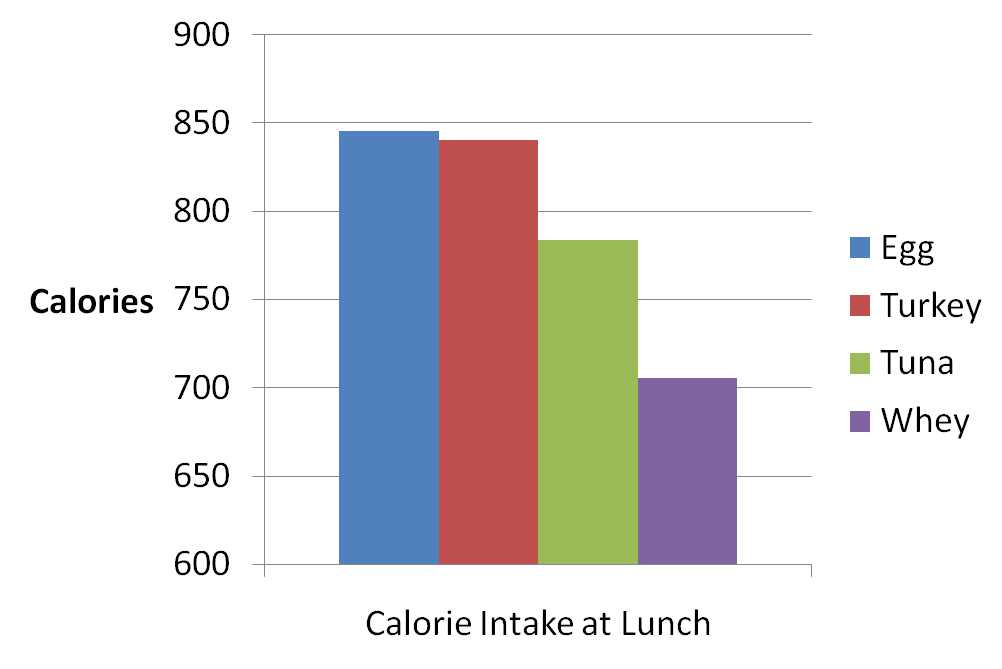
Calorie intake at a lunch consumed 4 hours after consuming various protein
The subjects ate nearly 150 calories less at lunch when they had whey protein, which also caused the greatest insulin response. In fact, there was an extremely strong inverse correlation between insulin and food intake (a correlation of -0.93).
Here's data from another study that looked at the insulin response to a meal that contained 485 calories, 102 grams of protein, 18 grams of carbohydrate, and almost no fat:
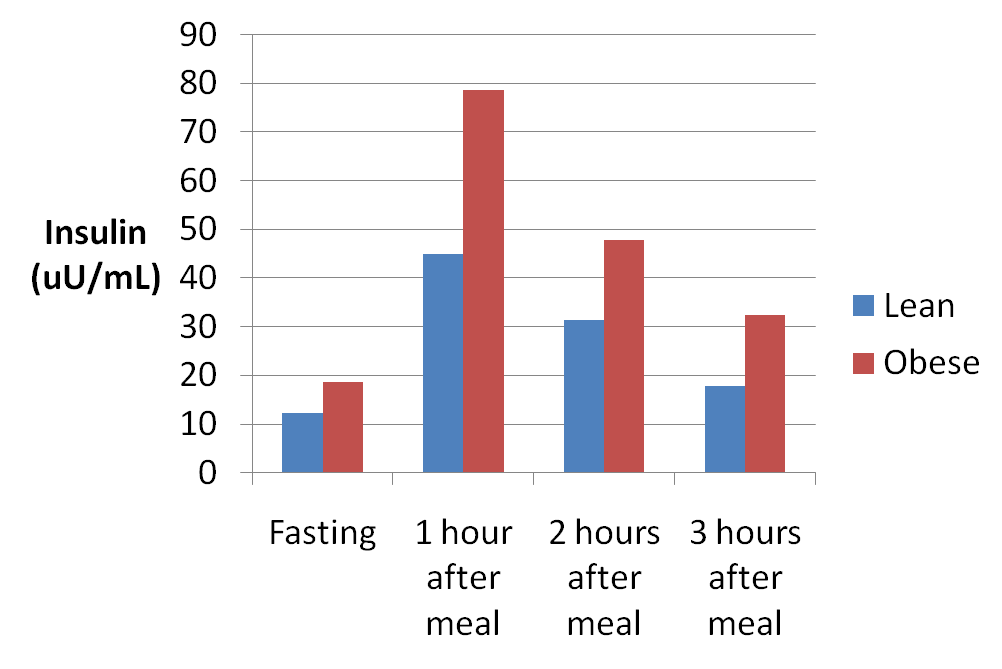
Insulin response to a high protein, low carb meal in lean and obese people
You can see that the insulin response was exaggerated in the obese subjects, probably due to insulin resistance. Here's a chart of the blood glucose response. You can see there was no relationship between the glucose response and insulin, which was similar to the study discussed earlier.
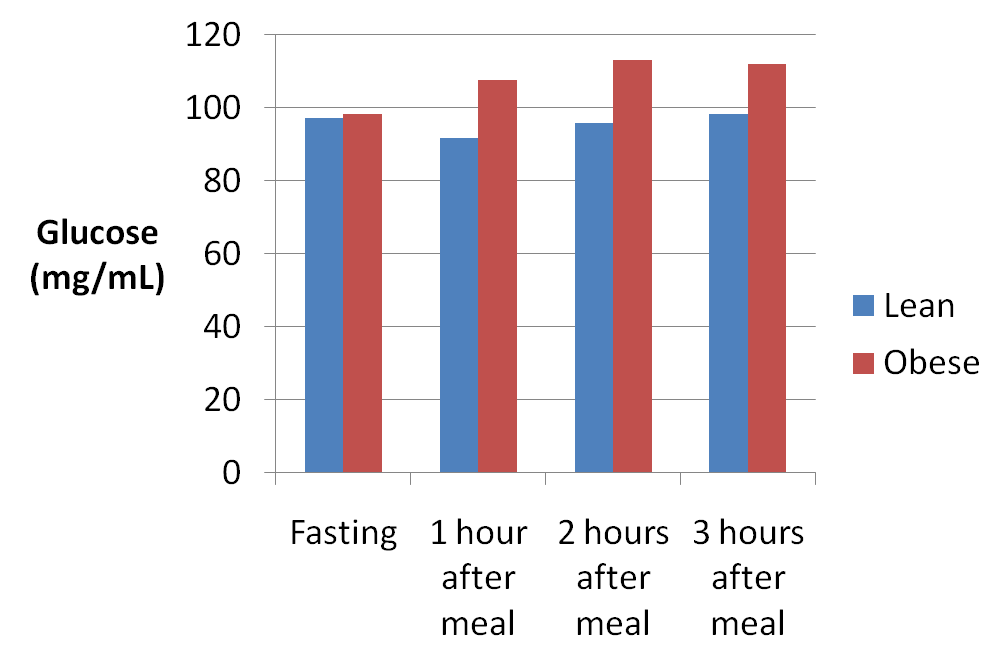
Blood glucose response in response to a high protein, low carb meal in lean and obese
The fact is that protein is a potent stimulator of insulin secretion, and this insulin secretion is not related to changes in blood sugar or gluconeogenesis from the protein. In fact, one study found beef to stimulate just as much insulin secretion as brown rice. The blood sugar response of 38 different foods could only explain 23% of the variability in insulin secretion in this study. Thus, there's a lot more that's behind insulin secretion than just carbohydrate.
So how can protein cause rapid rises in insulin, as shown in the whey protein study earlier? Amino acids (the building blocks of protein) can directly stimulate your pancreas to produce insulin, without having to be converted to glucose first. For example, the amino acid leucine directly stimulates pancreas cells to produce insulin, and there's a direct dose-response relationship (i.e., the more leucine, the more insulin is produced).
Some might say, "Well, sure, protein causes insulin secretion, but this won't suppress fat-burning because it also causes glucagon secretion, which counteracts insulin's effects." I mentioned earlier how insulin will suppress lipolysis. Well, some people think that glucagon increases lipolysis to cancel this out.
The thought that glucagon increases lipolysis is based on 3 things: the fact that human fat tissue has glucagon receptors, the fact that glucagon increases lipolysis in animals, and the fact that glucagon has been shown to increase lipolysis in human fat cells in vitro (in a cell culture). However, what happens in vitro isn't necessarily what happens in vivo (in your body). We have a case here where newer data has overturned old thinking. Research using modern techniques has shown that glucagon does not increase lipolysis in humans. Other research using the same techniques has shown similar results. I will also note that this research failed to find any lipolytic effect in vitro.
It should be remembered why glucagon is released in response to protein in the first place. Since protein stimulates insulin secretion, it would cause a rapid drop in blood glucose if no carbohydrate is consumed with the protein. Glucagon prevents this rapid drop in blood sugar by stimulating the liver to produce glucose.
Insulin: Not Such a Villain After All
The fact is that insulin is not this terrible, fat-producing hormone that must be kept as low as possible. It is an important hormone for appetite and blood sugar regulation. In fact, if you truly wanted to keep insulin as low as possible, then you wouldn't eat a high protein diet...you would eat a low protein, low carbohydrate, high fat diet. However, I don't see anybody recommending that.
I'm sure some are having some cognitive dissonance reading this article right now. I know because I experienced the same disbelief years ago when I first discovered this paper and how protein caused large insulin responses. At the time, I had the same belief that others have...that insulin had to be kept under control and as low as possible, and that spikes in insulin were a bad thing. I had difficulty reconciling that study and my beliefs regarding insulin. However, as time went on, and as I read more research, I learned that my beliefs regarding insulin were simply wrong.
Now, you may be wondering why refined carbohydrates can be a problem. Many people think it's due to the rapid spikes in insulin. However, it's obviously not the insulin, because protein can cause rapid spikes in insulin as well. One problem with refined carbohydrate is a problem of energy density. With refined carbohydrate, it is easier to pack a lot of calories into a small package. Not only that, but foods with high energy density are often not as satiating as foods with low energy density. In fact, when it comes to high-carbohydrate foods, energy density is a strong predictor of a food's ability to create satiety (i.e., low-energy density foods create more satiety). There are other issues with refined carbohydrate as well that are beyond the scope of this article.
The bottom line is that insulin doesn't deserve the bad reputation it's been given. It's one of the main reasons why protein helps reduce hunger. You will get insulin spikes even on a low-carb, high-protein diet. Rather than worrying about insulin, you should worry about whatever diet works the best for you in regards to satiety and sustainability. As mentioned in a previous article, individual responses to particular diets are highly variable and what works for one person will not necessarily work for another. I will be writing a post in the future on the need for individualized approaches to nutrition.
Click here to read part 2 of this series on insulin.
Further to Ian’s question; Do we have any studies showing that we can induce insulin resistance by overfeeding protein? I’m not aware of any. Presumably, insulin resistance could be induced by protein portions just as readily as with an equivalent portion/s of insulinogenic carbohydrate (i.e. by a portion of carb that provokes the same insulin response as the portion of protein)? I’m wondering about this, and hypothesising that perhaps insulin resistance isn’t merely a response to hyperinsulinemia (brought about by excessive carbs or proteins), but is actually a response to hyperglycemia? This would explain why excessive protein doesn’t seem to… Read more »
Harry,
I’m not aware of any studies specifically overfeeding on protein and looking at insulin resistance.
The whole concept of insulin resistance and hyperinsulinemia is a chicken/egg problem that scientists still haven’t quite solved. There is data indicating insulin resistance to come first, with hyperinsulinemia as a compensatory mechanism, but there’s also data indicating hyperinsulinemia to contribute to insulin resistance. It may very well be that it works both ways. I personally believe that, in most cases, it starts with insulin resistance leading to hyperinsulinemia. The scientific data definitely supports that there are many causes to insulin resistance.
So… we can store fat very easily even w/o the presence of insulin. But I’ve read that we can’t access those fat stores when insulin is high, and in healthy people, like you said, insulin and blood sugar go down after a meal (so they don’t stay high)- but what about in overweight/obese people? My impression from what I’ve read about nutrition is that the problem is insulin resistance. So what do you think causes/contributes to that aside from excess calories?
Ian,
There are many causes to insulin resistance, including, but not limited to, sleep loss, stress, inactivity, certain medications, etc. Many of these things act synergistically to create a “perfect storm”, resulting in the high prevalence of insulin resistance and metabolic syndrome we have in our society.
Once again, thank you for posting this article. I hope that some folks will have some enlightenment regards to insulin especially the people from low carb talibans. I will link this article to several sites.
Aziz, Tan…thanks for your comments.
CarbSane….thanks for the correction about low protein, low carb, high fat….I didn’t know there were people out there recommending such diets.
Hi James, I recently stumbled on your site via Alan’s weblog. I had a very informative time reading your articles. Little confused though by this sentence: ”Insulin doesn’t just regulate blood sugar. It has other effects as well. For example, it stimulates your muscles to build new protein (a process called protein synthesis)” I was always under the impression insulin only has a permissive role in MPS. It does prevent MPB, but only with a marginal raise (15 mU/l Rennie et al. 2006). Supraphysiological do however stimulate MPS (1000 fold increase). I haven’t read the fulltext of the study you… Read more »
Dutchbb, Thanks for your comment. The confusion regarding insulin and protein synthesis comes from differences in study design. From the paper I referenced: The notion that insulin stimulates skeletal muscle protein synthesis in adult humans has long been debated because some studies reported that insulin administration was unable to stimulate muscle protein synthesis while it decreased protein breakdown (8, 9, 21), whereas several others reported an increase in protein synthesis with no change in breakdown (6, 46–48).We have previously discussed this issue at length (10–12, 18), suggesting that differences in vasodilation and amino acid delivery might have explained these discrepancies.… Read more »
This paper might help you:
http://ajpendo.physiology.org/cgi/content/abstract/295/3/E595
Thanks James and Lucas.
I dug up the full-text of the first study and read Lucas’s reference but honestly most is way above my head. I have no background in physiology or exercise science whatsoever, just a genuine interest in the science behind bodybuilding.
But what does this mean for practical applications? Where the good old bro’s right and is ‘spiking up ur insulin’ a good thing afterall?
Dutch,
In terms of practical application, it doesn’t mean you purposely try to cause insulin spikes. It is more to dispel the notion that insulin spikes are inherently a bad thing. I will be a doing a follow-up post on this in the future, and discuss a drug that actually restores insulin spikes in type 2 diabetics and also causes weight loss.
The take home message is that insulin is released every time you eat. Insulin has a permissive role in MPS and MPB, as shown in the paper I linked. For switching the net protein balance after a workout you need aminoacids and insulin, period. Now the problem is you dont need that much insulin to get its maximal effects. The threshold seems to be around 30-60uU/mL. Consider that a whey protein shake (most widely used PWO) is very insulinogenic.
From the study you cite in the HSL discussion: “Arteriovenous NEFA concentration differences across the forearm did not change with either oral or intravenous lipid load. This suggests that there is no release into the circulation of LPL-derived fatty acids from skeletal muscle. This efficient entrapment of fatty acids in skeletal muscle occurred despite a high-fat load and lack of an insulin response. This is in contrast to what is seen in adipose tissue, where there is no significant trapping of fatty acids in the tissue with either oral or intravenous fat load.” “With both oral and intravenous fat load,… Read more »
“With both oral and intravenous fat load, NEFA transcapillary flux across adipose tissue was strongly negative (outward flow) in the fasting state, becoming close to zero at 180- 240 min before becoming strongly negative again (Fig. 7A). After a mixed meal, NEFA transcapillary flux becomes positive after 60 min and stays strongly positive until at least 300 min (15). The different responses can be attributed partly to the lack of reesterification after fat loading and partly to the earlier return of HSL activity.” This mixed meal only contained 10 grams of carbohydrate. Remember that a low-carb diet is not carbohydrate-free.… Read more »
More importantly, a low-carb diet is not protein-free (like the oral fat load in the study was IIRC). Glucogenic amino acids can provide substrate for glycerol phosphate synthesis.
Regarding the “mixed meal”, this is the study cited: http://ajpendo.physiology.org/cgi/reprint/266/3/E308?ijkey=13f80d732949a64d5baf093d4613ae2a0ec360fb
They used 80g of fat and 80g of CHO.
I (and I think James also) were referring to this study: Effects of an oral and intravenous fat load on adipose tissue and forearm lipid metabolism.
The test meal in the study was 9.6 g carbs, 40.3 g fat, 2.8 g protein.
Our point was that it’s not suprising that little reesterification was occurring because there’s not a lot of substrate available for glycerol phosphate synthesis when the diet contained only about 10 grams of carbohydrate and 3 grams of protein. This is not a typical low-carb meal (especially the protein content).
I dont know why I can post my original reply. Is there a limit of links or something permited per post?
Yes, usually posts with lots of links go in the spam folder. Your post should appear now.
Sorry for the untidiness (dont know how to post “clean links” here). The effect of incorporating fat into different components of a meal on gastric emptying and postprandial blood glucose and insulin responses: http://journals.cambridge.org/action/displayFulltext?type=1&fid=863376&jid=&volumeId=&issueId=02&aid=863372&bodyId=&membershipNumber=&societyETOCSession= Effects of Fat on Gastric Emptying of and the Glycemic, Insulin, and Incretin Responses to a Carbohydrate Meal in Type 2 Diabetes: http://jcem.endojournals.org/cgi/reprint/91/6/2062 Effects of gastric emptying on the postprandial ghrelin response: http://ajpendo.physiology.org/cgi/reprint/290/2/E389 The Lipid Messenger OEA Links Dietary Fat Intake to Satiety: http://www.cell.com/cell-metabolism/retrieve/pii/S1550413108002465 A high-fat diet raises fasting plasma CCK but does not affect upper gut motility, PYY, and ghrelin, or energy intake during CCK-8… Read more »
Fat seems to, if anything, increase insulin response. Not sure about fat+protein, but in studies with potato meals, added fat decreases the glucose response with similar or enhanced insulin response.
There are studies where fat added to carbohydrate meals increase the insulin response, others show that fat reduces it. I have found one study where fat increased the insulin response to protein. (http://www.ajcn.org/cgi/content/abstract/37/6/941) The problem interpreting these results is that the response is measured only for a couple of meals (no long term effect) and individual variation is important regarding insulin secretion. As I have said before, what is relevant is the effect that a diet has on postprandial and basal insulin levels, not a single meal. You can see that after a LCKD the postprandial insulin response is reduced… Read more »
One study (sorry I don’t have the links handy) see a glucose amelioration adding fat to the first potato meal but not a second 4 hrs later.
this paper demonstrates that the human body can handle significant doses of carbs w/o fat accumulation.
While insulin responses can be varied, calorie balance always finds a way 😉
While insulin responses can be varied, calorie balance always finds a way
Dont get me wrong, calories do count.
I would add that near as I can tell, the Atkins Fat Fast was specifically designed to treat those with extreme insulin resistance to lower insulin levels. That is why the meager protein rations are split between 5-6 “meals”. But it is telling that Atkins also severely limited calories. If fat calories had nothing to do with fat accumulation there would have been no need for this. I think Atkins knew just about anyone will lose weight eating like this and catabolizing some LBM in the process, but if left to their own devices to “eat when hungry, stop when… Read more »
I think it’s noteworthy that Dr. Atkin’s didn’t recommend this approach unless a person was truly in a weightloss stall, and only for a few days. It wasn’t intended to be a daily WOE.
Excellent! A bit of irony in there. Biggest insulin response was for whey and leucine. Guess what’s the mainstay of the first two weeks of the Eades misguided 6 Week Cure for the Middle Aged Middle diet? LOL Most of the folks who tried that diet lost most of their weight those first two weeks. Although they never gave a reason, the Eades were adamant about you getting in your shakes. Insulin was coarsing through my veins! In fact, if you truly wanted to keep insulin as low as possible, then you wouldn’t eat a high protein diet…you would eat… Read more »
This was a ridiculously informative yet simple read. Definitely sharing this one.
Thanks man. This was a very informative essay and I learned a lot. I am following a “primal” way of eating which is high fat (55), regular protein (30), low carb (15). Of course these are just approximate numbers and I think that stressing about percentages is not healthy. Low carb is easily achieved, not because I’m carbophobic, but because I took off processed foods and grains (again if I want some bread some day, no stress), which I think are not optimal for reasons other than insulin. You’re then left with fruits and veggies, from which it is difficult… Read more »
You state this “The fact is that insulin is not this terrible, fat-producing hormone that must be kept as low as possible. It is an important hormone for appetite and blood sugar regulation. In fact, if you truly wanted to keep insulin as low as possible, then you wouldn’t eat a high protein diet…you would eat a low protein, low carbohydrate, high fat diet. However, I don’t see anybody recommending that.” I ask Why NOT? No-one has shown that a low carb /high fat diet is harmful. In fact it was shown as long ago as 1926, by Stefansson, to… Read more »